
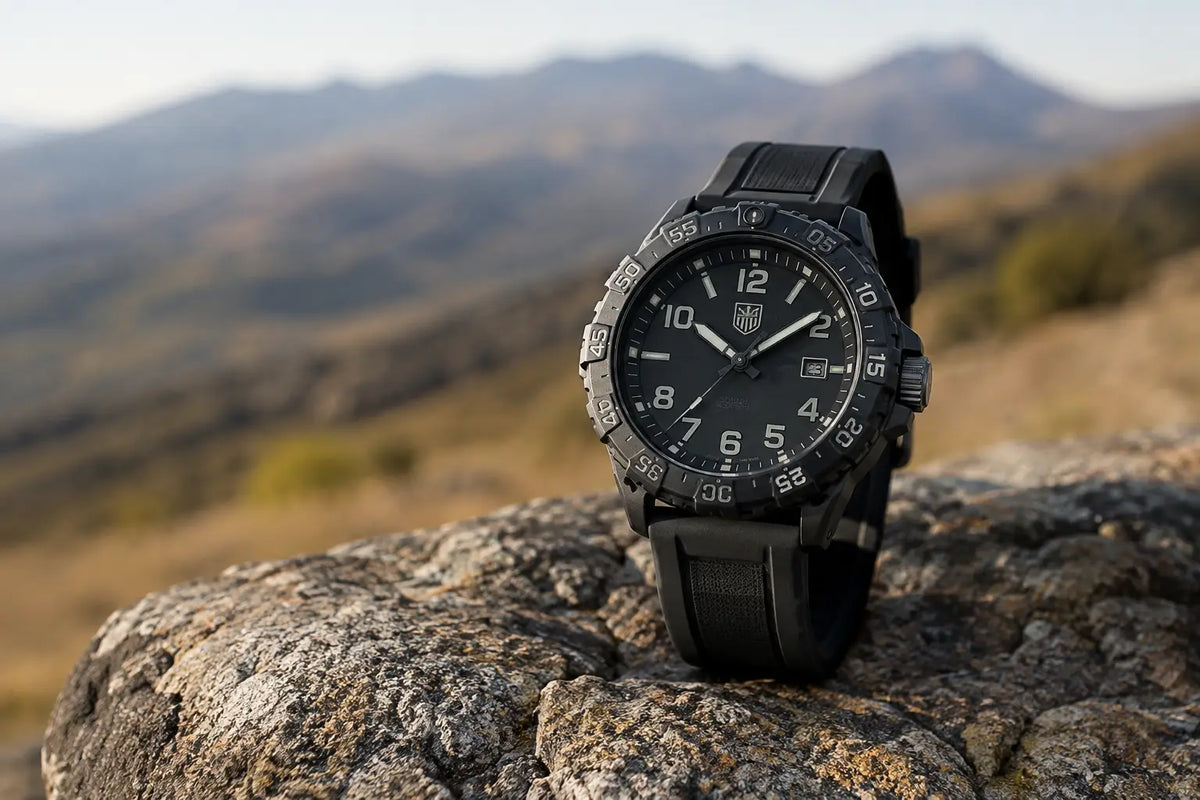
A field watch earns its place by being readable at 0400, comfortable under a sleeve and dependable when the weather turns. That is the useful starting point for any Luminox Atacama review. This is not a dress watch trying to look tactical. The Atacama range is designed around the requirements that matter to service personnel, security users and outdoor kit users: immediate time reading, hard-wearing materials and a purposeful, uncomplicated layout.
Luminox has built its reputation on watches that remain visible in low light without needing to be charged by a torch or held under a lamp. The Atacama family applies that familiar Luminox approach to a more conventional field-watch format. It is a sensible choice for someone who wants a capable daily watch rather than a large, overtly military statement piece.
Luminox Atacama review: the field-watch proposition
The Atacama name refers to one of the harshest environments on earth, which gives a fair indication of the design brief. These watches generally combine a round steel case, a protected crown, clear Arabic numerals or prominent hour markers, and a date display on many references. They look at home with combat clothing, patrol kit and civilian outdoor layers alike.
The strongest point is legibility. A watch is no use if its dial needs studying, particularly when you are moving between daylight, vehicles and dark interiors. Atacama models use high-contrast layouts and Luminox Light Technology, often referred to as LLT. Small tritium gas tubes illuminate the hands and markers continuously, with no button press or external charging required. On applicable models, Luminox states this illumination can remain effective for up to 25 years.
That does not mean the dial looks like a floodlight. In darkness, the tubes provide a clear, steady reference rather than a harsh glow. For night navigation, early starts, sentry duties or simply checking the time without waking the person beside you, it is a genuine advantage over standard luminous paint.
Atacama references vary in dial arrangement, case size, strap and bezel treatment, so it is worth checking the exact specification before choosing. Some versions lean towards a clean three-hand field watch, while others add a rotating bezel or chronograph functions. The underlying principle remains the same: give the wearer the information needed at a glance, without filling the dial with unnecessary detail.
Build quality and materials
Most Luminox Atacama models use a stainless-steel case. This gives the watch reassuring weight and better resistance to everyday knocks than lightweight fashion-watch construction, while keeping the appearance suitably restrained. Brushed surfaces are particularly practical as they disguise minor marks better than highly polished finishes.
Sapphire crystal is another important feature on many models in the range. Sapphire has excellent scratch resistance, which matters if the watch is regularly exposed to webbing hardware, door frames, tools, rock or general field use. It is not indestructible - a direct, heavy impact can still damage any crystal - but it is a worthwhile upgrade over basic mineral glass for a watch intended to be worn hard.
Water resistance is usually suitable for day-to-day wet weather, washing and outdoor use, but the rating must be checked against the particular reference. A field watch with a stated 100-metre water-resistance rating offers useful security around rain, river crossings and surface swimming. It should not automatically be treated as a dedicated dive instrument, especially if it has pushers or a chronograph complication.
The crown is generally sized for practical use rather than styled as a decorative feature. That is welcome when adjusting the watch with cold fingers. On the other hand, a large crown can occasionally press into the back of the hand during press-ups, lifting or prolonged wrist flexion. This is a common compromise with functional field-watch cases rather than a specific Atacama fault.
Straps and day-to-day comfort
Depending on the model, the Atacama may be supplied with a leather, rubber, NATO-style fabric or metal bracelet option. Each changes the character of the watch considerably. Leather gives a smarter finish for routine wear but needs more care after repeated soaking. Rubber is practical for wet, dirty work and easy to clean. A fabric strap is light, secure and can be replaced cheaply if damaged, while a steel bracelet is durable but adds weight.
For operational-style use, a fabric or rubber strap is often the most sensible pairing. They sit securely over a base layer, do not mind rain and are less likely to become uncomfortable during long periods of wear. If a supplied strap does not suit your work, standard strap compatibility on many models makes changing it straightforward.
Case diameter is the other comfort consideration. The Atacama is generally more restrained than Luminox’s larger dive and tactical designs, but it is still a substantial watch by traditional field-watch standards. Those with smaller wrists should compare the case diameter, thickness and lug-to-lug measurement rather than relying on photos. A watch can be perfectly manageable on a larger wrist yet feel top-heavy when worn beneath a close-fitting jacket cuff.
Accuracy, operation and real-world reliability
Many Atacama watches use Swiss quartz movements. For a working watch, quartz is often the practical answer. It is accurate, low-maintenance and ready whenever it is needed. There is no requirement to wind it, no loss of time after a quiet weekend, and no concern about whether your activity level has kept an automatic movement running.
The trade-off is that a battery will eventually need replacing. This is routine maintenance, not a drawback unique to Luminox, but it should be carried out carefully to preserve the water-resistance seals. If your watch sees frequent wet-weather or water use, having the seals checked during a battery change is sensible practice.
Chronograph versions offer useful timing for training serials, vehicle checks, cooking, travel legs or range administration. They are not essential for everyone. A straightforward three-hand model is quicker to read, less busy and usually the better choice if your priority is timekeeping rather than elapsed-time measurement. Choose the complication because you will use it, not because it looks more technical.
The LLT system is the standout reliability feature. Standard luminous material can be bright immediately after exposure to light, then fade through the night. Tritium tubes provide lower-level but consistent illumination. For a bedside watch this may be a nice extra; for a patrol, camping or shift-work watch, it is a proper functional benefit.
Who should buy a Luminox Atacama?
The Luminox Atacama suits buyers who want a credible field watch without moving into the oversized look associated with some tactical timepieces. It is particularly well suited to military personnel, veterans, police and security staff, instructors, cadet-force adults and outdoor users who value clarity over ornament.
It also makes sense for someone replacing a conventional analogue watch that has poor low-light performance. If you work irregular hours, travel before daylight or spend time under canvas, the always-on illumination quickly becomes more useful than it first appears.
There are limits. If you need mapping, GPS tracks, alerts, heart-rate data or navigation prompts, a dedicated GPS watch will serve you better. If you want a slim watch for formal dress, the Atacama’s field construction may feel too purposeful. And if deep diving is the main task, choose a watch specifically rated and equipped for diving rather than treating a general field watch as a substitute.
Is the Atacama good value?
Value depends on whether the Luminox features match your actual use. You are paying for a recognised Swiss watch brand, a hard-wearing case construction, quality crystal on many references and the tritium illumination system. For wearers who regularly need to read the time in darkness, that last point separates it from many similarly priced analogue watches.
It is less compelling if it will spend its life in an office, where a standard quartz watch can cover the basics for less. But kit should be judged by the job it needs to do. For practical users, the Atacama offers the sensible middle ground between a basic field watch and a complex digital instrument.
When selecting one, prioritise the exact case size, water-resistance rating, crystal type and strap material over cosmetic details. A watch that fits properly and can be read instantly is the one that will stay on your wrist when the rest of the kit is being checked before heading out.