
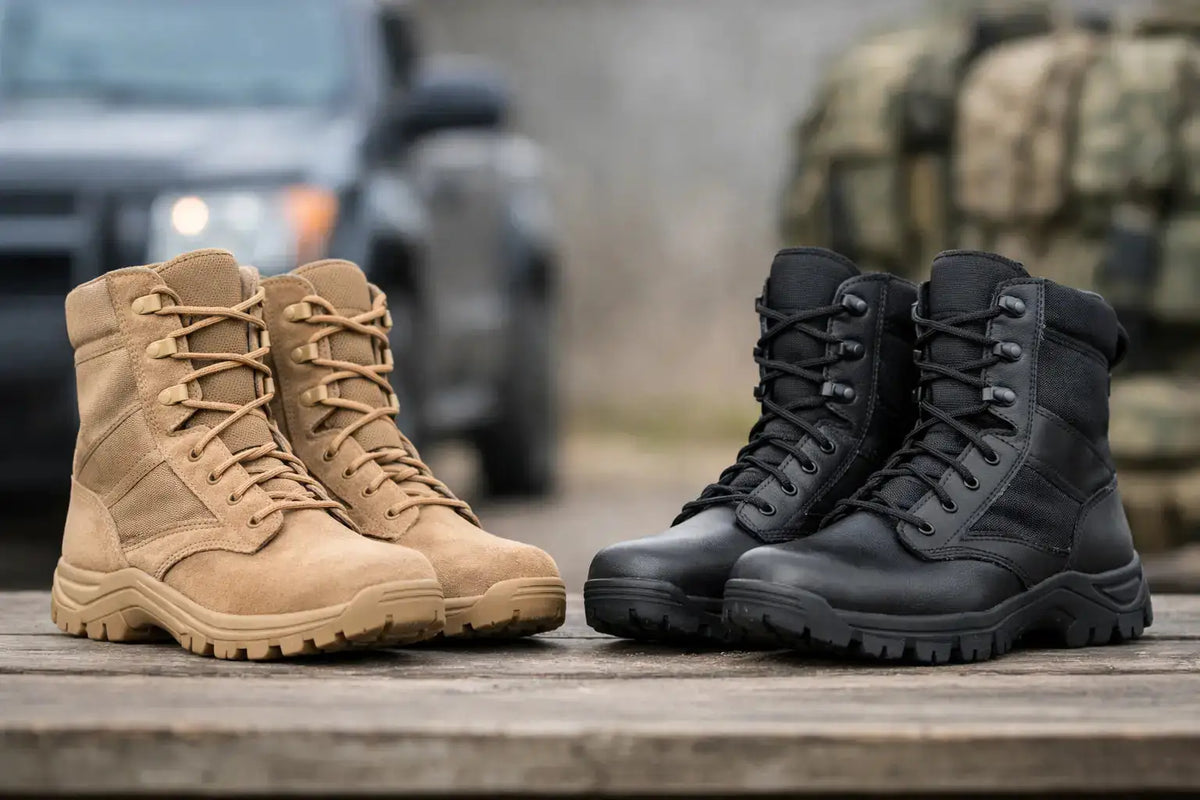
If you spend long hours on your feet, the difference between patrol boots vs combat boots stops being a catalogue question and becomes a comfort, performance and fatigue issue. The right pair can help you move faster, stay steadier under load and finish a shift or exercise with fewer problems than you started with.
For many buyers, the confusion comes from overlap. Both styles are hard-wearing, both are built for demanding use, and both sit firmly in the military and tactical market. But they are not the same tool. One is generally shaped around fast movement, long wear and lighter load demands. The other is usually built with harsher ground, heavier kit and tougher field conditions in mind.
Patrol boots vs combat boots: the core difference
At the simplest level, patrol boots are designed for mobility and all-day wear in policing, security, guard duties and lighter tactical roles. Combat boots are designed for field use where terrain, load carriage and protection matter more. That does not mean every patrol boot is soft or every combat boot is heavy, but it is the clearest dividing line.
A patrol boot usually feels lighter out of the box. It tends to have more flex through the forefoot, a lower-bulk build and a sole unit intended for pavement, mixed urban ground and general duty use. Comfort over long shifts is a major priority, especially where you are in and out of vehicles, moving on hard surfaces or standing for extended periods.
A combat boot generally puts more emphasis on ankle support, underfoot stability and durability in rough terrain. It is more likely to have a stiffer sole, a more substantial upper and construction that copes better with mud, scrub, wet ground and repeated load-bearing use. If you are tabbing, training in the field or carrying a bergan over distance, those features matter.
Where patrol boots make more sense
Patrol boots suit users who need speed, comfort and a tidy, duty-ready profile. Police officers, security staff, response teams, airsoft players and anyone working mostly on roads, concrete, packed tracks or built-up environments often lean towards this style for good reason.
The main advantage is reduced fatigue. A lighter boot with more flex can make a long shift more manageable, particularly if your day involves constant stepping in and out of vehicles, climbing stairs or walking hard surfaces for hours. The boot is working with you rather than resisting each stride.
Patrol boots also tend to feel less bulky around the ankle and lower leg. For some wearers, that improves agility and comfort straight away. If your role values quick foot movement and day-long wear over maximum protection from rough ground, this can be the better trade-off.
That said, there is a limit. A lighter patrol boot may not give the same support when carrying substantial weight, and it may wear faster if used hard in field conditions. If your environment turns from tarmac to churned-up training area every other day, the comfort gain can be offset by reduced stability and shorter service life.
Where combat boots earn their place
Combat boots are built for a different job. They come into their own when the ground is uneven, the load is heavier and the day is less predictable. Military training, fieldcraft, hill work, range use and outdoor tasks in poor conditions all favour a boot with more structure.
The extra support is often the first thing people notice. A combat boot usually keeps the foot more planted over broken ground and offers more confidence on cambers, ruts and wet surfaces. That matters when you are carrying kit, moving over distance or working in conditions where a rolled ankle is more than just an inconvenience.
Protection is another factor. Thicker materials, tougher randing on some models and a stronger sole package can help the boot stand up to abrasion, moisture and repeated punishment. You are often trading a little immediate comfort and flexibility for more resilience over time.
The drawback is obvious enough. Combat boots can feel heavier, warmer and slower than patrol boots, especially in urban use. On concrete or during vehicle-heavy duties, a stiff field boot may feel like overkill. If the job does not demand that extra structure, you may end up carrying unnecessary weight on every step.
Weight, support and flexibility
If you are choosing between the two, these three points usually decide it.
Weight affects fatigue. Even a modest difference becomes noticeable after a full day or a long route. Patrol boots usually win here, though lightweight combat boots have narrowed the gap.
Support matters most when load increases or terrain worsens. Combat boots are usually stronger in this area, with a stiffer platform and more secure feel through the ankle and midfoot. That support can reduce strain when carrying webbing, armour or a loaded pack.
Flexibility influences how natural the boot feels. Patrol boots generally bend more easily and need less breaking in. Combat boots often take longer to soften, but that extra stiffness is part of what gives them better field performance.
The key is not to chase one feature in isolation. A boot that feels excellent on a shop floor can be the wrong choice on a wet training area. Equally, the most supportive field boot in the world may be a poor option for routine patrol on hard standing.
Sole grip and terrain
Outsole design is often overlooked until conditions get poor. Patrol boots commonly use tread patterns that perform well on urban surfaces and mixed light terrain. They are made for reliable grip on pavement, indoor flooring, kerbs and ordinary outdoor ground.
Combat boots usually have a deeper, more aggressive tread pattern aimed at mud, loose soil and rough country. They are less likely to clog quickly and tend to give better bite when the ground turns soft. That can be the difference between steady footing and wasted effort.
There is no perfect sole for every surface. Aggressive lugs can feel less comfortable on hard man-made ground, while smoother duty soles can struggle in heavy mud. If most of your time is spent in one environment, buy for that reality rather than the occasional edge case.
Waterproofing, breathability and climate
The patrol boots vs combat boots decision also changes with weather and season. Some buyers want full waterproof membranes for wet UK conditions, while others would rather have better airflow and faster drying.
A waterproof combat boot is often a strong choice for field use in poor weather, particularly in colder months. It can keep you going longer in wet grass, standing water and muddy ground. The trade-off is that waterproof boots can run warmer and may take longer to dry inside if water gets over the collar.
Patrol boots are often chosen in more breathable formats because they suit heated vehicles, indoor work and long hours on hard surfaces. In warmer conditions, that can be a real benefit. The compromise is obvious enough in prolonged rain or soaked ground.
If your routine shifts between indoor, vehicle and outdoor use, think carefully about which problem is bigger for you: wet feet or overheating. There is no universal answer.
Fit matters more than category
A badly fitted patrol boot will perform worse than a properly fitted combat boot, and the reverse is equally true. Width, heel hold, instep pressure and toe room all matter more than labels on a product page.
A good fit should lock the heel without crushing the forefoot. You need room for your toes on descents and enough volume to work with your chosen socks, but not so much that the foot slides around. Friction, hot spots and fatigue often come from poor fit rather than poor boot design.
Different brands and lasts suit different feet. Some wearers need a narrow, close-fitting shape for control. Others need more room across the forefoot for comfort over distance. If you already know a particular brand fits you well, that can be more useful than broad claims about patrol or combat categories.
Which boot should you buy?
If your work is mainly urban, vehicle-based or focused on long duty wear, patrol boots are usually the more sensible purchase. They are quicker underfoot, often more comfortable from day one and better suited to hard surfaces and fast-paced movement.
If your use involves rough terrain, load carriage, field training or harsher outdoor conditions, combat boots are usually worth the extra structure and durability. They are built to cope when the ground, weather and task put more strain on both you and your kit.
For some users, the answer is not either-or. It is one pair for duty and another for field use. That is often the most practical approach if your routine genuinely covers both environments. A specialist retailer such as John Bull Clothing makes that easier because the range is built around actual military, patrol and tactical use rather than generic outdoor categories.
The right boot is the one that matches where you move, what you carry and how long you wear it. Buy for the job you actually do, not the one printed on the label.