
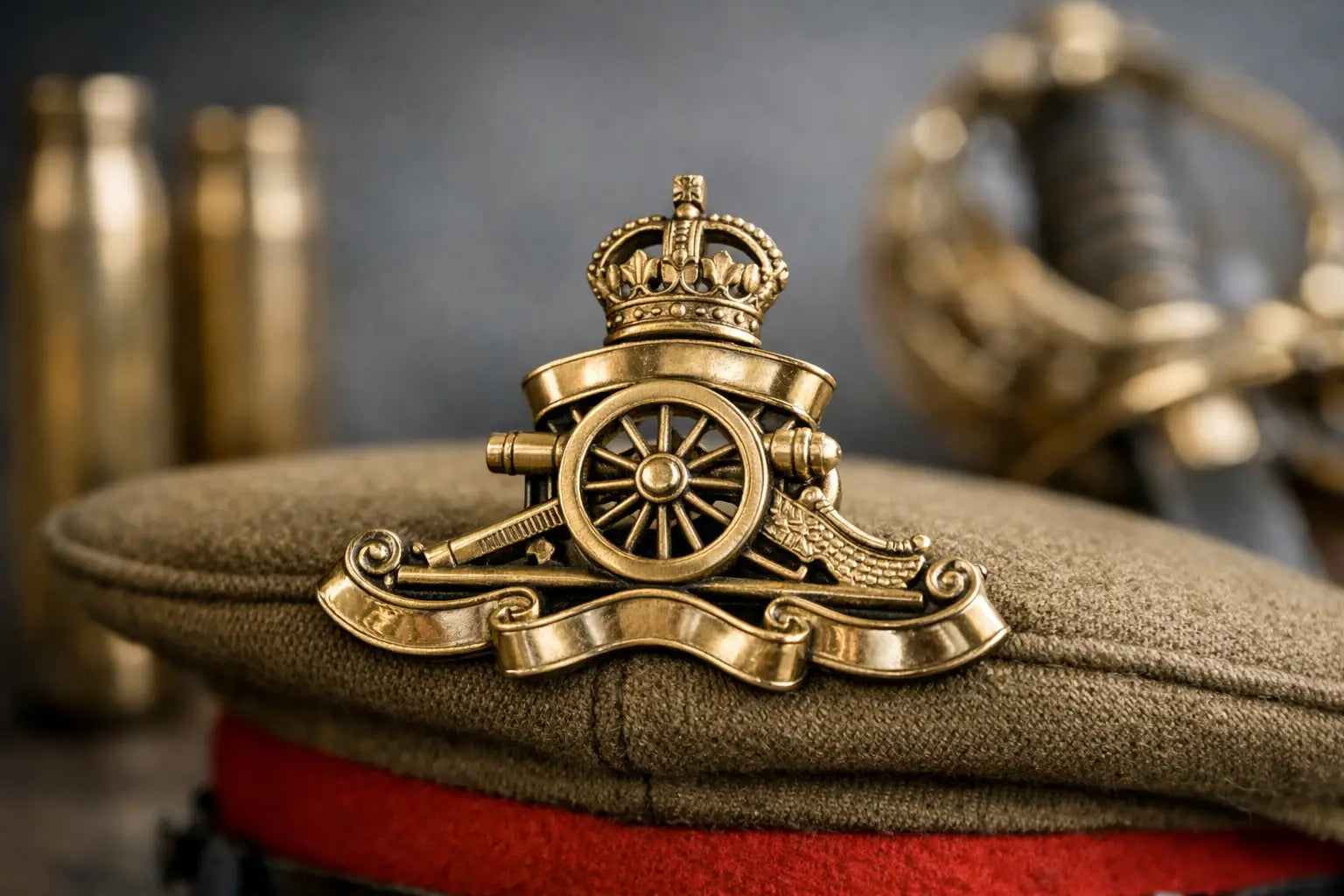
A Royal Artillery cap badge is a small piece of regimental insignia, but it carries a great deal of history. For serving personnel, veterans and cadets, it is immediately recognisable by the field gun, the Royal Cypher and the regiment’s long-established mottos. For collectors and families buying a commemorative gift, the detail matters just as much: pattern, finish, fittings and condition all affect whether a badge is right for wear, display or presentation.
What a Royal Artillery cap badge represents
The badge is built around the Royal Artillery’s most familiar emblem: a field gun surmounted by a crown. Beneath it sit the words Ubique and Quo Fas et Gloria Ducunt. Together, these reflect the regiment’s broad service history and its role in supporting the Army wherever required.
Ubique translates as “Everywhere”, a distinction awarded in place of individual battle honours. The lower motto, Quo Fas et Gloria Ducunt, is generally understood as “Whither right and glory lead”. These are not decorative additions. They are the details that make the badge distinct from a generic artillery motif and give it proper regimental character.
The design has appeared in different forms over time. Crowns, lettering, gun detail, metal finish and attachment methods can vary according to the period, the item’s intended order of dress and the manufacturer. That is why a buyer should first decide what the badge is for. A current-style badge for a beret has different requirements from a vintage example for a collection or a framed presentation piece.
Royal Artillery cap badge design details to check
At a glance, most examples look similar. A closer inspection is where quality and suitability become clearer. The gun should have crisp, balanced detail, with legible scrollwork and mottos. On a well-made badge, the crown, wheel spokes and lettering remain defined rather than soft or indistinct.
Material is another useful guide. Traditional examples may be made from brass, white metal or bi-metal construction, while some modern items use anodised aluminium or other lighter materials. None is automatically better than another. It depends on the period and purpose. A lightweight anodised badge may be appropriate for modern military-style dress, whereas a heavier brass example may suit a heritage display or collector’s collection.
The reverse fittings deserve equal attention. Lugs, sliders and pins are not interchangeable in every use case. A badge intended for a beret commonly needs secure lugs that can be fitted through the material and held correctly behind it. A slider fitting can suit other forms of headdress or presentation mounting. If the badge will be worn, choose the fixing type before purchasing rather than trying to force an unsuitable fitting into place.
Finish also has a practical effect. A bright polished badge gives a smart ceremonial appearance but will show handling marks more readily. A subdued finish can be more appropriate for field-style or lower-profile dress, where permitted. For a display, the right choice is usually the one that matches the period of the accompanying items, whether that is a beret, rank slides, photographs or service memorabilia.
Current wear and historical collecting are different jobs
A cap badge for wear should be clean, secure and correctly matched to the headdress. It should not have bent lugs, loose parts or sharp edges that could damage the beret. For serving personnel and cadets, unit and dress instructions always take priority over general guidance. Insignia practice can differ by appointment, dress order and organisation.
A collecting badge is judged differently. Patina, maker marks, age-related wear and original fittings may add interest rather than reduce it. Cleaning an older badge too aggressively can remove the surface character that helps identify its age. If an item has genuine historical value, a dry, gentle clean is generally safer than polishing it to a bright finish.
Selecting the right badge for a beret
Before fitting a badge, make sure the beret is properly shaped and dry. A badge fitted to loose or distorted material will sit poorly and may pull at the cloth. Positioning should follow the relevant dress regulations or the established practice of the organisation concerned.
Take care when passing lugs through the beret. They should go through the material cleanly without enlarging the holes unnecessarily. Once fitted, the badge needs to sit flat against the front of the beret, not tip forwards or twist to one side. A badge that rotates during wear is usually a sign that the lugs are not secured correctly or that the beret material has stretched.
Avoid using adhesive as a substitute for the correct fitting. It can stain the material, weaken over time and make later replacement difficult. If a badge is for occasional ceremonial use, a correctly fitted pair of lugs remains the dependable option.
For cadets and families buying a first badge, it is sensible to check the exact requirement with the detachment or unit before ordering. The difference between a cap badge, collar badge and shoulder title is obvious to someone familiar with regimental dress, but less so when purchasing from a photograph. Getting the correct item first time saves unnecessary returns and prevents an otherwise smart turnout being let down by the wrong insignia.
Authenticity, condition and value
Not every older-looking badge is an original period piece. Reproductions have a legitimate place, particularly where an affordable badge is needed for a costume, a living-history display, replacement wear or a gift. Problems arise only when a reproduction is represented as an original.
Collectors should examine overall construction rather than relying on one feature. Look at the quality of the casting or stamping, the sharpness of the lettering, the style of the rear fittings and any manufacturer’s marks. Compare the badge with known examples from the same broad period. A very uniform artificial ageing finish, unusually soft detail or modern-looking fittings on a supposedly early badge should prompt further checks.
Condition affects value, but scarcity and provenance can matter more. A common badge in excellent condition may be a better choice for a framed gift than a rare but damaged example. Conversely, a badge with clear service provenance may hold special family significance even if its finish is worn. The most worthwhile piece is not always the brightest or the oldest. It is the one that fits the story you are preserving.
A strong choice for military presentation gifts
A Royal Artillery badge works particularly well in a regimental presentation frame alongside a photograph, service dates, rank insignia or a small engraved plaque. It can mark retirement, promotion, passing out, a birthday or remembrance of a family member’s service. The compact size makes it suitable for a desk display as well as a larger wall-mounted arrangement.
For a gift, aim for a badge that is clean, correctly finished and appropriate to the recipient’s connection with the regiment. A modern badge can be the practical choice for a serving soldier or cadet. A period example may carry greater meaning for a veteran or family researching a relative’s service. If there is uncertainty over era, using a well-presented current-style badge and clearly dating the accompanying inscription is often the safer route.
Storage matters once a badge is off the beret. Keep it dry, away from damp lofts, garages and direct sunlight. For brass or white-metal badges, a soft cloth pouch or lined display case helps prevent abrasion. Do not store bare metal items pressed together in a tin or drawer, as movement can scratch raised details and wear down the finish.
The best Royal Artillery cap badge is one chosen with a clear purpose: correctly fitted for wear, accurately matched to a collection, or properly presented as a lasting regimental gift. Take the time to check its pattern, fittings and condition, and it will look the part long after the initial presentation or parade day has passed.