
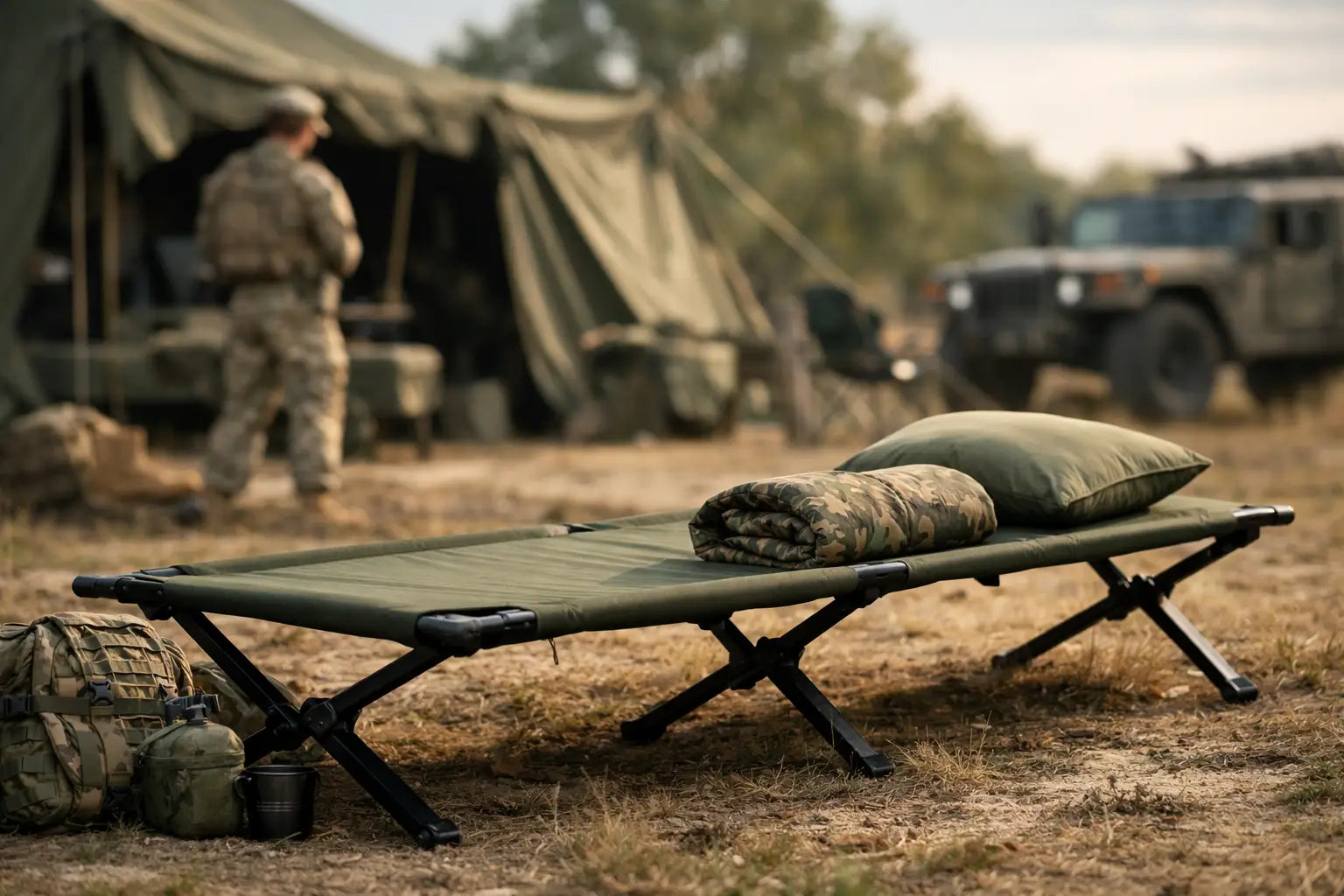
A poor night on the ground catches up with you quickly. Whether you are away on an exercise, supporting a cadet camp, working an event, fishing overnight or building a practical vehicle-based sleep system, a camp bed can make the difference between proper rest and a cold, uneven night. This army camp bed review focuses on the details that matter after the kit has been carried, assembled in poor light and used for more than one night.
A military-style camp bed is not simply a folding bed with an olive finish. It needs to support your weight without sagging, stand securely on imperfect ground and pack down to a sensible size. The right choice depends on how you travel, the sleeping bag and mat you use, and whether comfort or minimum pack weight takes priority.
What a Good Army Camp Bed Should Deliver
The principal benefit is ground clearance. Raising your sleeping system clear of the floor keeps you away from surface moisture, stones, roots and the cold ground. It also makes getting dressed, sorting kit and standing up considerably easier, particularly for older users or anyone recovering after a demanding day.
A capable bed should have a firm frame, secure locking points and a taut sleeping surface. Steel frames usually offer excellent stability and a reassuring load capacity, but they add weight. Aluminium models are easier to move from vehicle to tent and suit users who need to keep bulk under control, although the build quality of the joints matters more than the frame material alone.
Do not judge a bed solely by its stated weight rating. That figure is useful, but it does not explain how the bed behaves when you turn over, sit on the edge or place kit at your feet. Look for wide, well-supported legs, positive hinges and feet that will not sink immediately into soft groundsheet material.
Army Camp Bed Review: Frame, Fabric and Fittings
The frame is where long-term value is decided. A folding design with exposed scissor joints is quick to deploy and normally very stable once open, but it can be bulky when packed. Beds with separate poles and tensioned fabric often pack smaller, yet can take longer to assemble and may require more hand strength to fit the final bar.
For regular camp use, simple mechanisms are generally preferable. A bed that opens cleanly in a confined tent is more useful than one that saves a small amount of packed length but demands a struggle at the end of a wet day. Check that fingers can be kept clear of folding joints and that the locking system is obvious rather than relying on guesswork in low light.
Fabric should feel substantial and remain taut under load. Heavy-duty polyester or similar coated technical fabric is common, with reinforced attachment points at the corners and along the side rails. A loose surface is not merely less comfortable: it allows the body to settle into a hollow, making it harder to turn during the night. Stitching should be even and reinforced where the fabric bears against the frame.
Take notice of the feet. Broad plastic feet protect groundsheets and spread load better than narrow metal ends. They are especially worthwhile on soft grass, loose soil and tent floors. On hard surfaces, rubberised feet can reduce movement and prevent unnecessary marking.
Comfort Is More Than a Raised Sleeping Surface
A camp bed does not replace insulation. Air circulating beneath you can make a raised bed feel colder than sleeping directly on a well-insulated mat, particularly in spring, autumn and winter. Use an insulated sleeping mat or suitable foam layer on top of the bed, then select a sleeping bag rated for the expected conditions.
Bed width is equally significant. A narrow cot may be acceptable for a compact one-night set-up, but side sleepers and larger-framed users will appreciate additional room. The practical issue is not only shoulder width. You need enough space to turn without catching an elbow on a frame rail or feeling as though you will roll off the edge.
Length deserves the same scrutiny. Taller users should allow room for a pillow and avoid having their heels pushed against the end bar. If you sleep with clothing or a jacket at the foot of the bed, that extra usable length becomes more valuable.
Some users add a self-inflating mat for comfort, while others prefer a closed-cell foam mat for straightforward reliability. Either can work. A self-inflating mat gives more cushioning and packs smaller, but foam has no valve or puncture risk and remains useful around camp during the day.
Packed Size and Transport Considerations
A heavier folding camp bed is often the sensible option when travelling by car, van or military transport. It is quick to issue, quick to recover and generally able to tolerate repeated handling. For base camps, field events, fishing shelters and family camping, this type of bed is hard to beat.
If you must carry your own kit any distance, be realistic. Even a well-made camp bed can be awkward when combined with a bergen, sleeping system, waterproofs, rations and personal equipment. Compact pole-style cots are better suited to this role, but assess whether the reduced packed size justifies the longer set-up time and potentially higher price.
Measure the available tent space before buying. Camp beds take up more room than their sleeping dimensions suggest because of the feet, frame ends and access needed to get in and out. In a narrow two-person tent, one wide bed may leave little space for kit. A larger field tent, however, can accommodate beds while keeping equipment dry and organised underneath.
Set-Up and Use in Camp
Set the bed up on the flattest section of ground available, with the legs fully opened and each lock engaged. Do not use it as a bench for several people, and avoid dropping heavily onto the surface. Camp beds are designed for distributed sleeping loads, not rough treatment around the fire point.
Keep the fabric clean and dry where possible. Mud trapped in folding hinges can accelerate wear, while a damp packed bed can lead to mildew and unpleasant odours. After a wet camp, open the bed at home or in a dry storage area, wipe down the frame and allow the fabric to air fully before returning it to its bag.
Check bolts, rivets, hinge points and fabric tension periodically. A minor issue found before departure is straightforward to deal with. A damaged joint discovered at 2200 hours in a cold tent is a different matter.
Who Should Choose a Camp Bed?
A camp bed suits anyone who values sleep quality and can accept the extra weight and bulk. It is particularly useful for multi-day camps, static field locations, cadet activities, event support crews and outdoor users travelling by vehicle. It can also be an excellent option for guests at home, provided the bed is intended for indoor use and the feet will not mark the floor.
For lightweight backpacking, a bed is usually not the first choice. A quality insulated mat delivers a far better weight-to-comfort balance when every item has to be carried. Likewise, if your shelter has a very low roof, confirm that there is enough headroom to sit up from the raised surface.
At John Bull Clothing, the most useful approach is to match field sleeping kit to the task rather than buying on appearance alone. A dependable steel-framed bed may be ideal for a vehicle-supported camp, while a compact cot better suits limited storage and regular transport.
Final Checks Before You Buy
Confirm the bed's assembled dimensions, packed dimensions and stated load capacity. Then consider the less obvious points: whether it fits your tent, whether you can carry it comfortably, how it performs with your preferred sleeping mat, and whether replacement or spare storage bags are available if required.
The best camp bed is the one you will actually take, set up without frustration and sleep soundly on. Choose a stable frame, allow for insulation underneath you, and give yourself enough width to recover properly for the next day.