
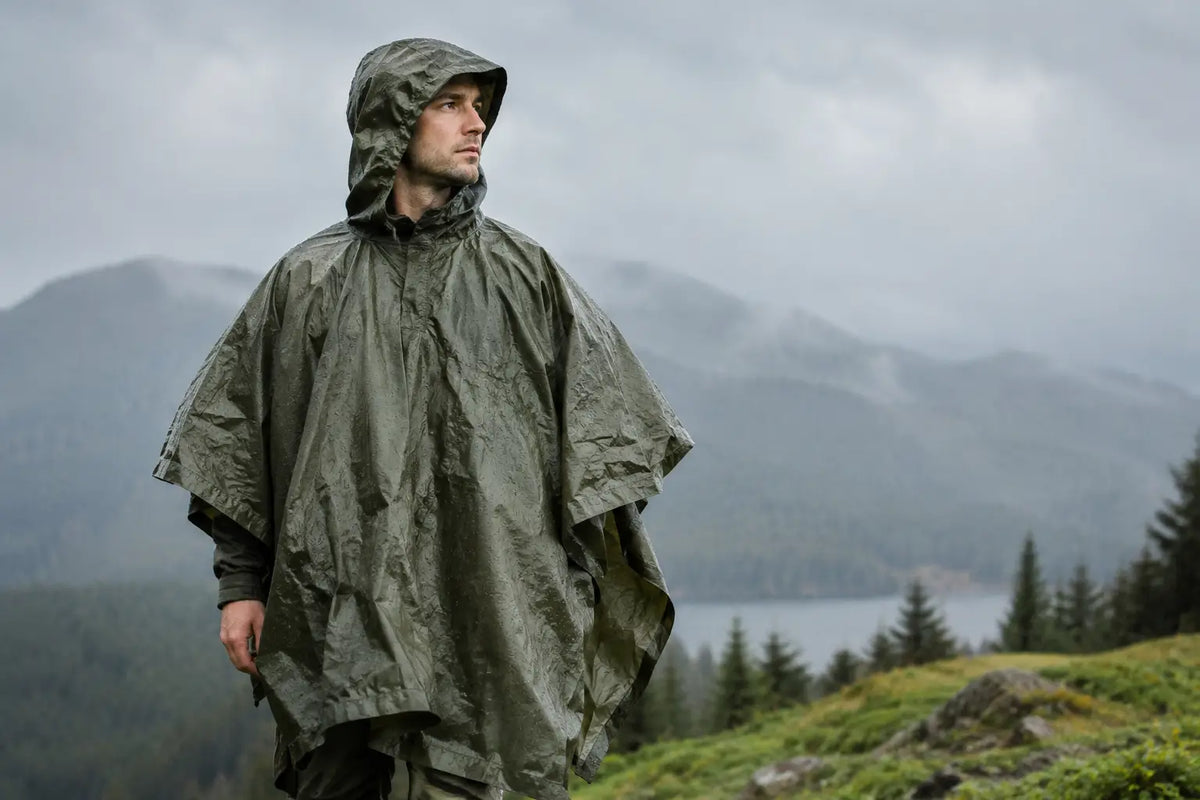
Rain arriving halfway through a tab is not the time to discover that your waterproof layer will not cover your bergan, snag on webbing or hold up in a strong crosswind. This military poncho guide sets out what a poncho does well, where it falls short, and how to choose one that earns space in your field kit.
A good military poncho is more than an oversized waterproof. It is a fast-deployed layer that can cover the wearer and equipment, provide a ground sheet or casualty cover, and form part of a basic shelter system. That flexibility is the reason it remains useful alongside modern waterproof jackets, rather than being replaced by them.
Military poncho guide: choose the right construction
The first decision is material. Traditional rubberised or PVC ponchos are tough, fully waterproof and generally affordable. They suit vehicle kits, range days, fishing, dog walking and occasional field use, but they can feel heavy, noisy and clammy when working hard. In warm, wet conditions, moisture from inside the poncho can become as uncomfortable as rain from outside.
Nylon and polyester ponchos with a polyurethane coating are usually lighter to carry and dry more quickly after use. Look for a stated waterproof coating, taped or properly sealed seams, and reinforced eyelets if shelter use is part of the plan. A lightweight poncho is sensible for a day sack, but very thin material is more vulnerable to punctures from branches, wire and sharp edges on webbing.
Ripstop fabric is a practical feature rather than a marketing extra. The reinforcing grid can limit the spread of a small tear, which matters when the poncho is used over equipment or pitched under tension. It will not make a lightweight fabric indestructible, so avoid dragging it over rough ground or forcing it through dense scrub.
Camouflage is another functional choice. British DPM remains popular for surplus and cadet use, while MTP-style patterns better suit current British Forces-inspired field kit. Solid olive, coyote or black may work better for security, bushcraft and general outdoor use. Match the pattern to the environment and your existing load carriage, but remember that unit dress policy and task requirements always take precedence over personal preference.
Cut, length and coverage
A poncho needs enough length to shed water away from your trousers without becoming a trip hazard. Longer cuts give better protection when static and provide more usable fabric for a shelter. Shorter cuts are easier around knees, steep ground and vehicles. For most users, a mid-thigh to knee-length design is the useful middle ground.
Check the width as closely as the length. A narrow poncho can cover a torso but may leave a daysack, radio pouch or the top of a bergan exposed. A generously cut military pattern should sit over a small or medium pack without pulling tight across the shoulders. If you routinely carry a large bergan, test the fit with it loaded. A separate pack cover may still be the better answer for sustained rain, particularly if the load is wider than the wearer.
A hood with an adjustable drawcord helps keep rain out and prevents the fabric obscuring vision in wind. It should accommodate a cap or helmet where required without becoming so loose that it catches gusts. Avoid cinching a hood so tightly that you lose peripheral awareness when moving near roads, on exercise or around other personnel.
When a poncho is better than a waterproof jacket
A waterproof jacket is the stronger choice for prolonged movement in wind, close terrain and technical tasks. It fits closer to the body, keeps loose fabric out of the way and is less likely to snag on vehicles or obstacles. A quality jacket and waterproof trousers also give more reliable protection when you must kneel, crawl or work with both hands.
The poncho comes into its own when conditions change quickly and you need coverage now. It can go over a belt kit, chest rig or day sack without stripping layers. It provides ventilation from below, which can make it more comfortable than a jacket during lower-intensity movement in mild weather. It is also useful when stopping for a brew, treating kit, waiting at a checkpoint or protecting insulation layers during a halt.
There is a trade-off. A poncho catches wind and can flap, make noise and expose the lower legs. It is not ideal for cycling, climbing, high-wind ridgelines or tasks involving machinery. It should also be kept well clear of naked flames and cookers. Most coated synthetic fabrics are vulnerable to sparks, and a hole above your head soon becomes a persistent leak.
Using a military poncho as a shelter
Many military ponchos have eyelets or attachment points around the edge. These allow the poncho to become a hasty basha, lean-to or low tarp when paired with cordage and suitable anchor points. This is valuable capability, but it should not be confused with a full shelter system in every season.
For a simple lean-to, pitch the rear edge lower than the front and angle it into the prevailing weather. Keep it taut enough for water to run off, but do not overstress eyelets or fabric. A shallow pitch sheds wind and rain better than a high, open shelter, although it reduces internal room. In foul weather, a low shelter that stays dry is worth more than standing headroom.
Do not rely on a poncho alone for an overnight system unless the forecast, ground conditions and your experience support it. You still need insulation from the ground, a sleeping system suited to the temperature, and a plan for condensation. If used as a ground sheet, inspect for stones and thorns first. The waterproof layer under you is only useful while it remains intact.
Carry a short length of cordage and a few practical attachment options if shelter use is intended. The exact method depends on training area rules and local ground conditions. Never cut live vegetation, damage fences or leave paracord behind. On military training areas, follow the relevant standing orders and any restrictions on basha building.
Field use, packing and maintenance
Pack a poncho where it can be reached without emptying the bergan. An outer pouch, top pocket or readily accessible dry bag makes sense. If it is buried beneath spare clothing, it is less likely to be used before uniform and equipment are already soaked.
After use, dry the poncho fully before long-term storage. Pay particular attention to folds, hood channels, press studs and eyelets, where moisture can linger. Mud and salt can shorten the life of coatings and hardware, so rinse as directed by the manufacturer and avoid harsh detergents, fabric conditioner or excessive heat.
Before an exercise, trip or patrol, check four areas: the hood adjustment, all press studs or fasteners, eyelets and seam condition. A small tear can often be repaired with a suitable patch before it spreads. Keep a compact repair option in the same pouch if the poncho is a core part of your wet-weather plan.
For dependable field kit, the cheapest option is not always the best value. Consider how often it will be carried, whether it must cover load carriage, and whether it may be used as shelter fabric. John Bull Clothing customers who need proven military-style equipment should prioritise sound construction and a fit suited to their actual load, rather than choosing solely by camouflage pattern.
A poncho works best when it is practised with before the weather turns. Put it on over your usual layers, test it over your pack, and pitch it once in controlled conditions. That short preparation is what turns a folded square of waterproof fabric into useful field equipment.