
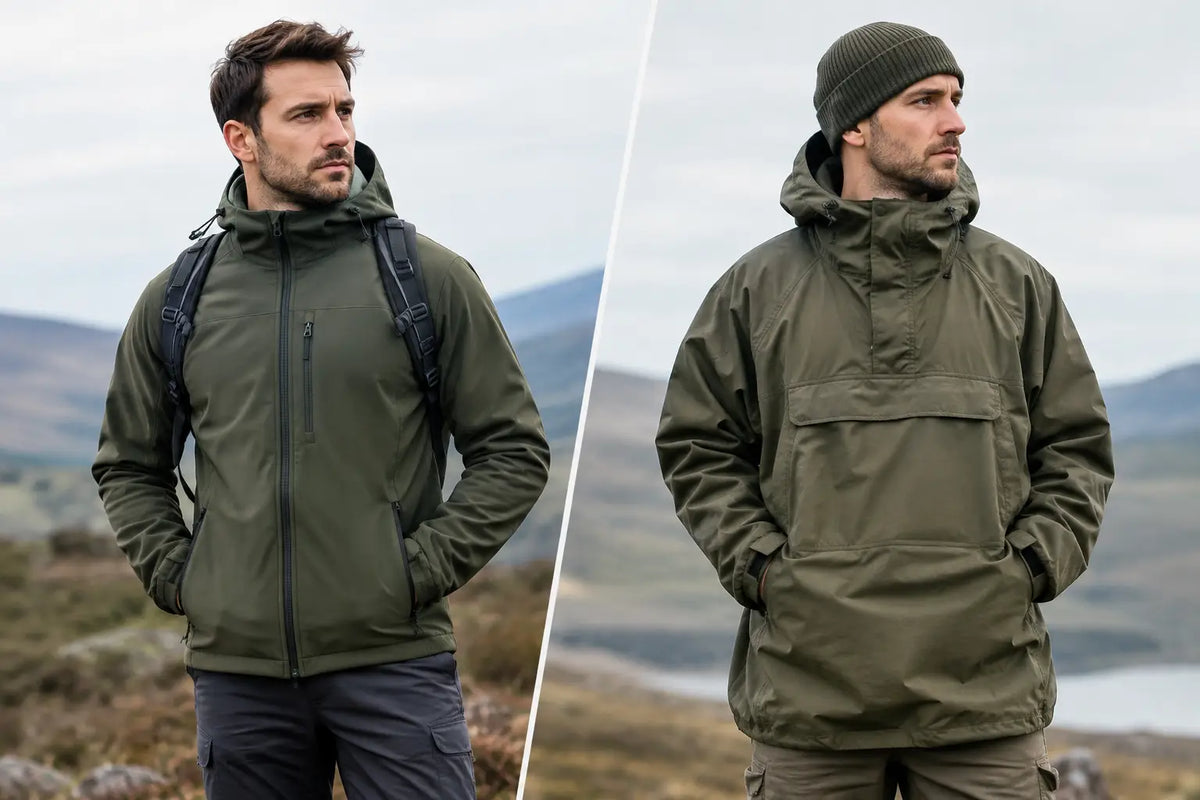
A softshell jacket vs smock choice is rarely about which garment is better. It is about what sits on your back, what the weather is doing, how hard you are moving, and whether you need immediate access to kit. A close-fitting softshell is built for movement and changeable conditions. A traditional military smock provides coverage, capacity and a looser fit for field use.
For patrols, ranges, cadet exercises, dog walking, hill days and airsoft, both have a place. Choosing the wrong one can leave you either sweating under a pack or short of pockets when you need them most.
Softshell jacket vs smock: the practical difference
A softshell jacket is usually a close-cut, zip-front layer made from woven synthetic fabric. It is designed to cut wind, shed light rain and allow better moisture transfer than a waterproof shell. Many styles use stretch panels or a mechanically stretchy weave, making them comfortable when climbing, shouldering a rifle, working from a vehicle or moving over uneven ground.
A smock is a field garment with military roots. It is generally longer in the body, more generously cut and equipped with large external pockets. Depending on the design, it may be a lightweight windproof layer, a tough polycotton outer or a waterproof garment. That last point matters: a smock is a style of garment, not a guarantee of waterproof performance.
The softshell prioritises mobility and active comfort. The smock prioritises coverage, storage and straightforward field utility. There is overlap, but their strengths are different.
When a softshell jacket earns its place
A softshell is often the better choice when you will be moving continuously in cool, breezy or mixed weather. It works particularly well during tabbing, navigation exercises, hill walking, range work and everyday outdoor use where a full waterproof shell would feel too warm.
The fabric blocks enough wind to prevent the chill from cutting through a base layer, while remaining more breathable than most waterproof membranes. If you stop for long periods, you can add insulation over or under it depending on the cut. A fleece-lined softshell offers more warmth, while an unlined version is more versatile across the seasons.
Its clean profile is also useful under a day sack, body armour or harness. There is less loose fabric to bunch around shoulder straps and fewer bulky pockets to interfere with a waist belt. A full front zip makes temperature control quick: open it on an ascent, close it when exposed on a ridge or standing on stag.
That said, softshells have limits. Their water-repellent finish will cope with drizzle, damp vegetation and short showers, but prolonged rain will eventually soak the outer fabric. Once wet through, they become heavier and lose much of their ability to protect against wind. Carrying a proper waterproof layer remains sensible where sustained rain is expected.
Why the smock remains field kit
A good smock is difficult to beat when you need practical storage and extra body coverage. The longer cut protects the lower back and seat better than a short jacket, particularly when kneeling, lying prone or working around camp. Its loose shape also makes it easy to throw over a base layer, fleece or light insulation without feeling restricted.
The large pockets are the defining feature. Map, notebook, gloves, head torch, brew kit, compass, field dressing and spare batteries can all be kept accessible without constantly opening a pack. For cadet instructors, bushcraft users, dog handlers and anyone spending time outdoors at a lower pace, that capacity is genuinely useful.
Smocks are available in several constructions. A lightweight windproof smock can be exceptionally breathable and quiet, making it suitable for dry, cool conditions. A durable polycotton smock handles rough ground, camp chores and repeated abrasion well, though it may dry more slowly after a soaking. Waterproof smocks offer greater rain protection, but will usually be warmer and less breathable during hard movement.
The trade-off is bulk. A loaded chest pocket can sit directly beneath pack straps or a plate carrier. A longer, looser garment can also catch more wind and feel less tidy when cycling, climbing or moving rapidly. If you wear webbing or armour for most of the day, test pocket access before committing to a particular smock layout.
Weather protection: do not confuse windproof with waterproof
The biggest buying mistake is expecting either garment to do every job. Softshells are normally water-resistant, not waterproof. Their durable water repellent treatment causes light rain to bead and run off, but it is not designed for hours of heavy rain.
A windproof smock may perform in much the same way. It will keep out a cold breeze and handle a shower, but it does not replace a waterproof jacket. Check the specification rather than relying on the word “smock”. Look for a stated waterproof membrane, taped seams and a suitable hood if rain protection is the priority.
For cold, dry weather, a softshell or windproof smock is often more comfortable than waterproof kit because moisture can escape more readily. For a wet training area, an exposed hill or a long static task in persistent rain, choose a proven waterproof shell or waterproof smock and manage ventilation carefully.
Layering, fit and what you carry
Fit should be judged over the layers you actually use. A softshell should allow a base layer and light fleece beneath it without pulling across the shoulders or riding up when you raise your arms. It should not be so loose that it loses the advantages of its streamlined cut.
A smock needs enough room for layering, but excessive size can make sleeves cumbersome and pockets awkward. Check that the cuffs seal properly over gloves, the hood moves with your head and the hem works with your belt, webbing or harness. A smock worn too tight loses its layering benefit; one worn too large becomes unnecessarily snag-prone.
Think about load carriage before choosing. A softshell suits users who keep most equipment in a pack, belt kit or chest rig. A smock suits those who want essential items on the garment itself. Neither approach is wrong, but they solve different problems.
Choosing for your task
For active walking, travelling light and general daily wear, an unlined or lightly insulated softshell is usually the most adaptable option. It is comfortable, packs reasonably well and looks less overtly military when that matters.
For woodland training, fieldcraft, camp duties and situations where maps, gloves and small tools need to be close at hand, a smock makes more sense. Its extra length and pocket capacity are practical advantages, not nostalgia.
For security, police or professional use, consider the rest of your system. If body armour, radio kit and a duty belt are part of the working setup, a low-bulk softshell may integrate better. If you operate without armour and need to carry navigational or administrative items externally, a smock can be the more useful outer layer.
For airsoft and tactical training, durability and pocket placement deserve more attention than camouflage alone. A tough smock is useful for woodland games and prone positions, while a softshell is often better for fast-paced events in cooler weather. Avoid overloading chest pockets if you will be wearing a rig all day.
Care that keeps performance intact
Softshell performance depends heavily on a clean outer fabric and a functioning water-repellent finish. Wash it according to the care label, avoid ordinary fabric conditioner and reproof it when water stops beading on the surface. Dirt, oil and detergent residue can reduce breathability and make the garment feel colder in wet weather.
Smocks should be checked for worn cuffs, damaged zips, loose buttons and pocket seams, especially after hard field use. Polycotton garments may benefit from straightforward repairs and can give long service if looked after. Waterproof smocks need the same cleaning and reproofing discipline as waterproof jackets, with particular attention to seam tape and high-wear areas under pack straps.
John Bull Clothing customers often buy for conditions rather than labels, which is the right approach. Match the garment to the pace of work, expected weather and the equipment you need to access during the day. A softshell and a smock are not competing answers to the same problem - for many users, they are two useful layers in the same kit system.
Before your next exercise or trip, put on your intended base layers, load your pack or webbing and move properly in the garment. Reach overhead, kneel, shoulder your kit and check every pocket. The jacket that works in the changing room is not always the one that works in the field.