
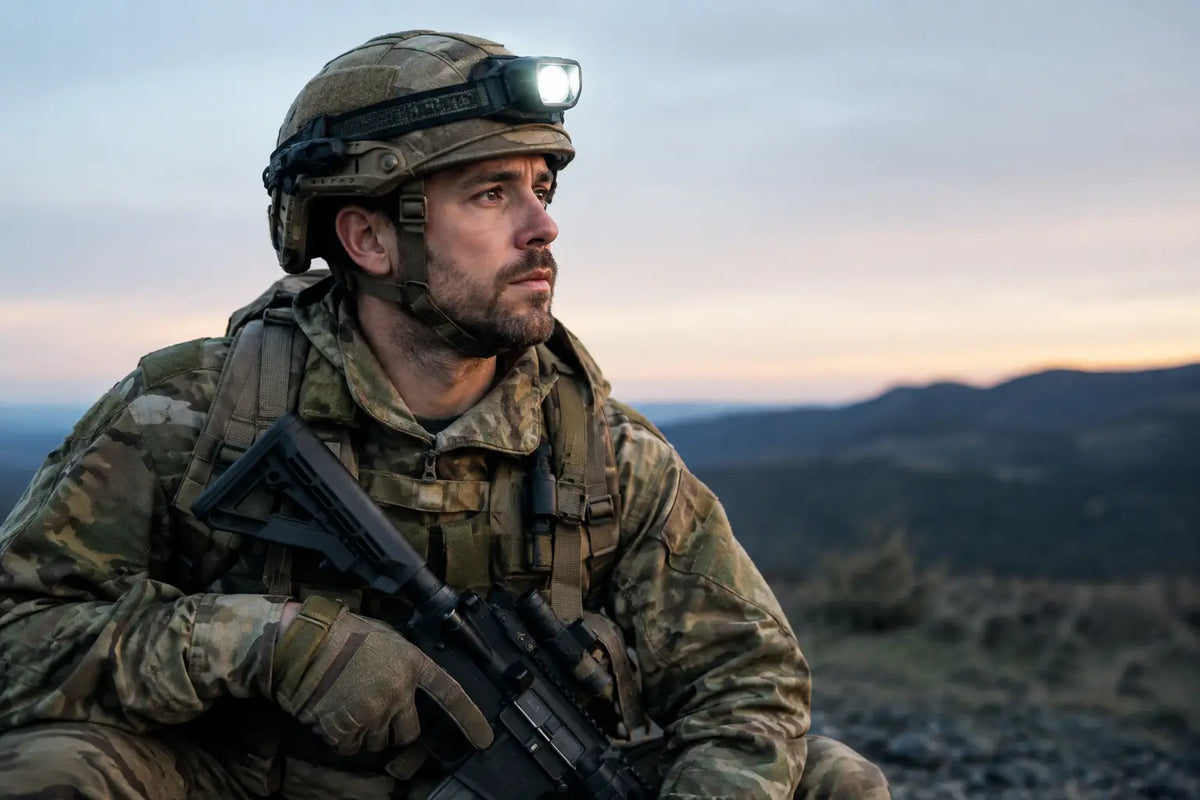
A head torch earns its place when both hands are occupied: checking a map under cover, sorting kit in a darkened harbour area, administering first aid, working on a vehicle or setting up a shelter after last light. This tactical head torch guide focuses on the details that matter in the field, rather than headline lumen figures alone. The right unit must be easy to operate under stress, secure on the head, economical with power and capable of giving useful light without compromising light discipline.
Start with the job, not the lumen figure
A high output may look impressive on a product specification, but maximum brightness is only one part of a dependable lighting system. For routine close work, such as reading a map, locating an item in a bergan or preparing food, a low white mode is normally more useful than a broad high-output beam. It protects night vision, reduces glare from nearby surfaces and preserves battery life.
Higher settings have their place. A focused beam is useful for route finding, identifying ground features, searching a treeline, checking a path or working across a larger area. The trade-off is clear: more output generally means shorter run time, more heat and greater visibility to others. A good tactical head torch provides several genuinely usable levels, so you can match the light to the task rather than relying on one overpowered setting.
Do not assume that a larger lumen number always means a better beam. Lumens describe total light output, while beam shape determines how effectively that light reaches the ground or target area. A broad flood beam suits camp tasks and close administration. A tighter spot beam carries further. Many field users benefit most from a combined beam or separate flood and spot settings, provided the controls remain simple.
Tactical head torch guide: choose the right light modes
White light is the general-purpose option because it gives the clearest colour recognition and the best working visibility. For navigation, equipment checks and casualty care, it remains the practical choice. The key is having a properly low level as well as a powerful high setting.
Red light is often preferred where preserving dark adaptation matters. It is useful when reading a map, moving around camp or carrying out close tasks without flooding the immediate area with white light. However, red light is not a universal answer. It can make some map markings, wires, stains and coloured equipment details harder to distinguish. Use it for discretion and low-level tasks, but change to low white light when accurate colour recognition is required.
Green light may appear on some tactical models and can offer good perceived contrast for certain tasks. Its usefulness is more personal and situation-dependent. Before relying on any coloured mode, practise with your own maps, kit and gloves in the conditions you expect to face.
A strobe setting can be useful for signalling or emergency identification, but it should not be the main reason for choosing a torch. More important is whether the unit offers direct access to a low mode or coloured mode without cycling through a glaring high setting first. That feature prevents accidental light discharge when light discipline matters.
Power options: disposable, rechargeable or hybrid
Battery choice affects more than cost. It determines how easily you can sustain the torch during extended use, cold weather and travel. Models using common AA or AAA batteries remain practical for field users because replacements are easy to source and spares can be carried in a waterproof pouch. Lithium primary cells generally perform better than alkaline batteries in low temperatures and have a longer storage life, making them a sound option for standby equipment.
Rechargeable head torches are convenient for routine training, dog walking, security work and short outdoor trips. USB charging reduces the need to hold several types of battery, and some units show a clear charge indicator. Their limitation is dependence on a power source. If the torch will be used for multiple nights away from vehicle power, consider whether you can recharge it reliably or carry a suitable power bank.
Hybrid systems give the greatest flexibility. Some torches run from a rechargeable pack but accept standard batteries through an adaptor or alternate compartment. This can be a worthwhile feature for users who need rechargeable convenience at home and field-serviceable power away from it.
Whatever system you choose, carry tested spares where the task justifies them. Keep batteries in a proper case, with terminals protected from loose metal items. Replace cells as a set where the manufacturer advises it, and do not mix different battery types or heavily used cells with new ones.
Controls must work with gloves and wet hands
A torch can have excellent output and still prove frustrating if the switch arrangement is poorly designed. Look for a control that can be found by touch, operated with gloves and used without removing the torch from your head. A recessed button may prevent accidental activation in a pocket or bergen, though it must not become too difficult to press in cold conditions.
Memory functions can be helpful, returning the torch to the mode last used. Yet they are not always ideal for tactical use. If the last setting was high white, an accidental activation can immediately ruin dark adaptation. For many users, a torch with a dedicated low or red-light button is the safer arrangement.
Lockout is another worthwhile feature. A mechanical or electronic lock prevents the torch switching on inside a pouch, which wastes battery and can leave you without light when needed. Check how the lockout works before deploying the torch. It should be quick to engage, but not so easy that it is activated by mistake.
Fit, mounting and helmet compatibility
A head torch that shifts while moving is more than an irritation. It can make route finding difficult, create inconsistent light on a task and become uncomfortable over a long period. A broad, adjustable elastic headband normally gives the best balance of stability and comfort for general field use. Test it over a beanie, hood or helmet cover if that reflects your normal kit.
Helmet mounting deserves particular attention. Some models attach directly to compatible helmet rails or shrouds, while others use straps, clips or adaptor plates. The most secure mount is not automatically the best one if it interferes with hearing protection, eye protection, camouflage scrim or helmet balance. Confirm compatibility with your own helmet before treating a torch as part of an operational set-up.
Weight matters as well. A compact torch is comfortable for navigation and short tasks, but a larger battery pack may offer much longer endurance. Rear-mounted battery packs can balance a front lamp, though they add cable routing and another point to inspect. For occasional use, simplicity usually wins. For prolonged night work, the extra capacity may justify the bulk.
Weather resistance and field durability
Look beyond a vague claim that a torch is water-resistant. An IP rating gives a clearer indication of protection against dust and water. A unit intended for regular outdoor use should cope with rain, mud and wet ground, but no electronic item should be treated carelessly around water unless its rating specifically supports immersion.
A sound hinged battery door, intact seals and a positive latch are as important as the casing itself. Inspect these areas regularly, especially after sandy, wet or cold-weather use. If the torch has an external cable or rechargeable port, check that its cover closes securely and is not fouled by grit.
Cold conditions reduce battery performance, particularly with alkaline cells. Carry spare batteries close to the body where practical, and test the torch before setting off rather than discovering a weak cell after dark. In hot weather, avoid leaving battery-powered equipment in direct sun inside a vehicle for long periods.
Set up your head torch before you need it
A new torch should not go straight into a pack. Fit it to your chosen headwear or helmet, learn every control by touch and practise changing between low white, high white and coloured modes without looking at the unit. Check its beam against your map case, watch face, gloves and other reflective equipment. Small pieces of shiny kit can throw more glare than expected.
Set your spare batteries, charger lead or power bank in a consistent location. If you use a pouch, make sure it can be opened quietly and with gloves. It is also sensible to carry a small independent back-up light. A head torch can fail, be damaged or be left behind, and a compact secondary light gives useful resilience without adding much weight.
The best choice is rarely the brightest model on the shelf. Select a tactical head torch with the beam pattern, power supply, controls and mounting method that suit your actual tasks. Once it is configured and practised with, keep it clean, keep it powered and treat it as the working item it is: a small piece of kit that can make a difficult night task safer and more manageable.