
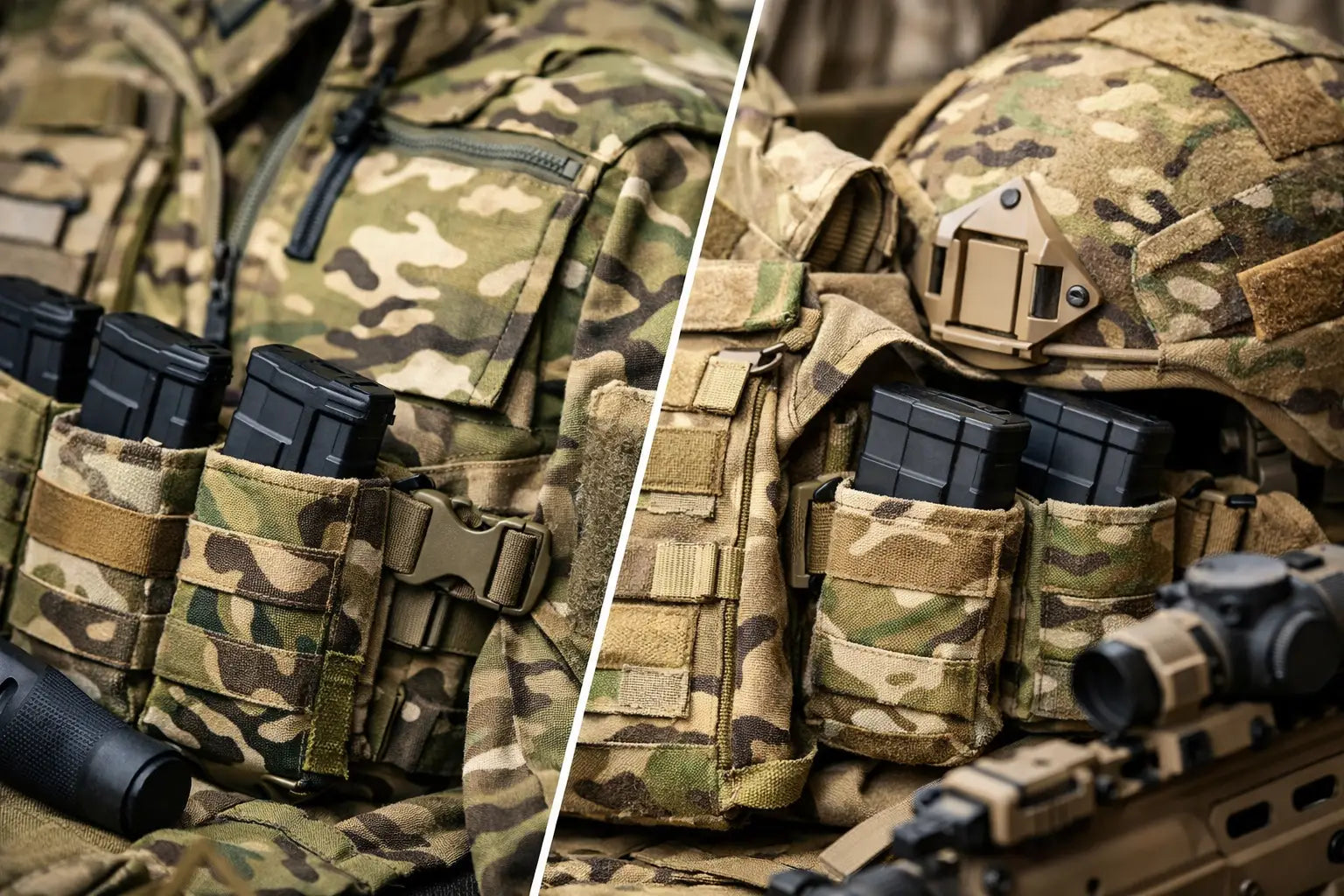
A camouflage label change can look minor on a product page, but it matters when you are matching clothing to webbing, working in mixed terrain, or replacing a trusted field layer. The question of why Keela Tactical changed from MTC camo pattern to Crye MultiCam camo is therefore less about fashion and more about supply, pattern recognition and practical compatibility.
The short answer is that Crye MultiCam is an established, widely recognised commercial camouflage platform. Moving to it can give a tactical clothing manufacturer clearer pattern consistency, broader market compatibility and more dependable access to licensed camouflage fabric. For the wearer, it generally means a familiar, proven multi-environment pattern that is easier to match with existing tactical equipment.
MTC and Crye MultiCam are not simply interchangeable names
It is worth separating the terminology before drawing conclusions. MTC is commonly used in product descriptions to mean a multi-terrain camouflage finish. It may describe a particular print, fabric supply route or brand-specific naming convention. Crye MultiCam, by contrast, is a named and licensed camouflage pattern developed by Crye Precision.
MultiCam is designed to work across a range of environments rather than being optimised for one backdrop alone. Its blend of greens, browns, tan and muted transitional tones helps it break up shape in woodland edges, dry grass, scrub, urban fringe and open ground. No camouflage works perfectly everywhere, but this broad-use approach is the reason MultiCam has been adopted or imitated so widely across tactical and outdoor markets.
It should not be confused with British MTP. The two patterns have a similar purpose and can appear broadly compatible at a distance, but they are distinct patterns. For personnel subject to dress regulations or unit requirements, that distinction remains important. Always check what is authorised before buying kit for work or formal use.
Why Keela Tactical changed from MTC camo pattern to Crye MultiCam camo
Unless a manufacturer issues a statement covering a specific garment or production run, it is not sensible to claim one single internal reason for a pattern change. In most cases, however, the move from an MTC-labelled pattern to genuine Crye MultiCam is likely driven by several practical considerations rather than a change in the garment's field purpose.
A recognised standard makes matching kit easier
For many buyers, the immediate benefit is familiarity. Crye MultiCam is used across a large range of tactical clothing, chest rigs, rucksacks, plate carriers, pouches, caps and load-carrying equipment. A clearly identified pattern gives the customer a better chance of matching a jacket or trouser with kit already in service.
Exact print shades still vary between manufacturers, fabric batches and materials. A lightweight ripstop shirt and a Cordura pouch will rarely look identical, even when both are MultiCam. That said, buying a recognised licensed pattern removes much of the uncertainty attached to generic descriptions such as multi-terrain camouflage.
Licensed fabric can support consistency
Camouflage is not only about the artwork. The quality of the print, colour repeat and base fabric all affect the finished garment. Working with a known pattern licence and established fabric supply chain can help a manufacturer maintain a more consistent appearance between production runs.
That matters to users replacing one item at a time. If a field smock, combat shirt or pair of trousers needs replacing after hard wear, most people want the new item to sit reasonably well with the rest of their equipment. A standardised camouflage name makes that purchasing decision more straightforward.
Demand extends beyond one user group
Keela Tactical clothing is bought by a broad cross-section of users: military personnel where permitted, police and security professionals, airsoft players, instructors, bushcraft users and serious outdoor customers. Not every buyer is sourcing kit around an issued pattern. Many are building a practical, modular clothing system from commercial equipment.
Crye MultiCam has strong recognition in that market. It gives a garment relevance outside a single organisation or niche, while retaining the subdued, field-ready appearance expected from tactical clothing. This is commercially useful, but it is also useful to the customer who needs replacement kit that will not be difficult to coordinate later.
Availability can be a deciding operational factor
The best-designed garment is of little use if the fabric cannot be obtained consistently. Textile availability, minimum order quantities, printing capacity and licensing arrangements can all influence the camouflage offered on a product line. These are normal realities of technical clothing manufacture.
A switch to Crye MultiCam may therefore help provide a more stable route for future production. It does not automatically mean the previous MTC pattern performed poorly. Often, a change reflects what can be supplied reliably at the required quality and volume.
What has changed for the wearer
In practical terms, the performance of the garment still comes first. Keela Tactical users should look at the cut, ventilation, fabric weight, pocket layout, weather protection and layering compatibility before focusing solely on the camouflage print. A well-made jacket in the wrong size or a trouser that restricts movement will be a greater problem than a small difference in pattern tone.
The main visible change is easier integration with commercially available MultiCam equipment. That may be useful if you already run a MultiCam daysack, helmet cover, belt kit or pouches. It can also make selecting a matching cap, gloves or lightweight outer layer less of a guessing game.
For concealment, the benefit depends on the ground. MultiCam performs best as a compromise pattern across changing terrain and light conditions. It is not a substitute for sound fieldcraft, correct movement or using natural cover. In dense British woodland during high summer, greener patterns may blend better. In dry grass, bracken, exposed soil and mixed vegetation, MultiCam's transitional palette can be particularly useful.
Consider the dress and task requirement first
A commercial MultiCam garment may be entirely suitable for range use, training, airsoft, security work where approved, stalking, outdoor instruction or personal field use. It may not be appropriate for every military workplace, exercise or deployment. Unit standing orders, force policy and task-specific PPE requirements take precedence over personal preference.
There is also the issue of mixing patterns. Combining MTP, MultiCam and similar multi-terrain prints is common in some informal settings, and at practical distances the difference may be limited. In a regulated environment, though, a mixed appearance can be unacceptable even if the colours are broadly similar. If you are buying for duty, establish the requirement before ordering.
For airsoft and civilian tactical use, the decision is more personal. A full matching setup looks tidy, but it is not always necessary. Prioritise clothing that is comfortable under load, dries quickly, allows access to pockets and stands up to repeated kneeling, crawling and washing.
How to buy the right Keela Tactical camouflage garment
Start with the job the garment must do. For wet, exposed conditions, look for the right outer-layer protection and enough room for insulation beneath. For warm-weather activity, a lighter, more breathable combat layer may make better sense. If you spend long periods wearing body armour or a pack, check where the seams, pockets and adjustment points sit.
Then assess the pattern against your existing equipment and the area where it will be used. If most of your load carriage is Crye MultiCam, the move away from MTC simplifies matching. If you already own MTP or another camouflage system, compare the item in daylight if appearance and uniformity matter to you.
Finally, check the product specification rather than relying on photographs alone. Screen settings, studio lighting and fabric texture can alter perceived colour. Confirm whether the garment is described as genuine Crye MultiCam, identify the material and choose the size around the layers you genuinely wear in the field.
The move to Crye MultiCam is best viewed as a practical update: one that gives Keela Tactical garments a recognised commercial camouflage identity and gives buyers clearer options when assembling dependable field kit. Choose the pattern that suits your permissions, terrain and existing equipment, then let fit and function make the final decision.