
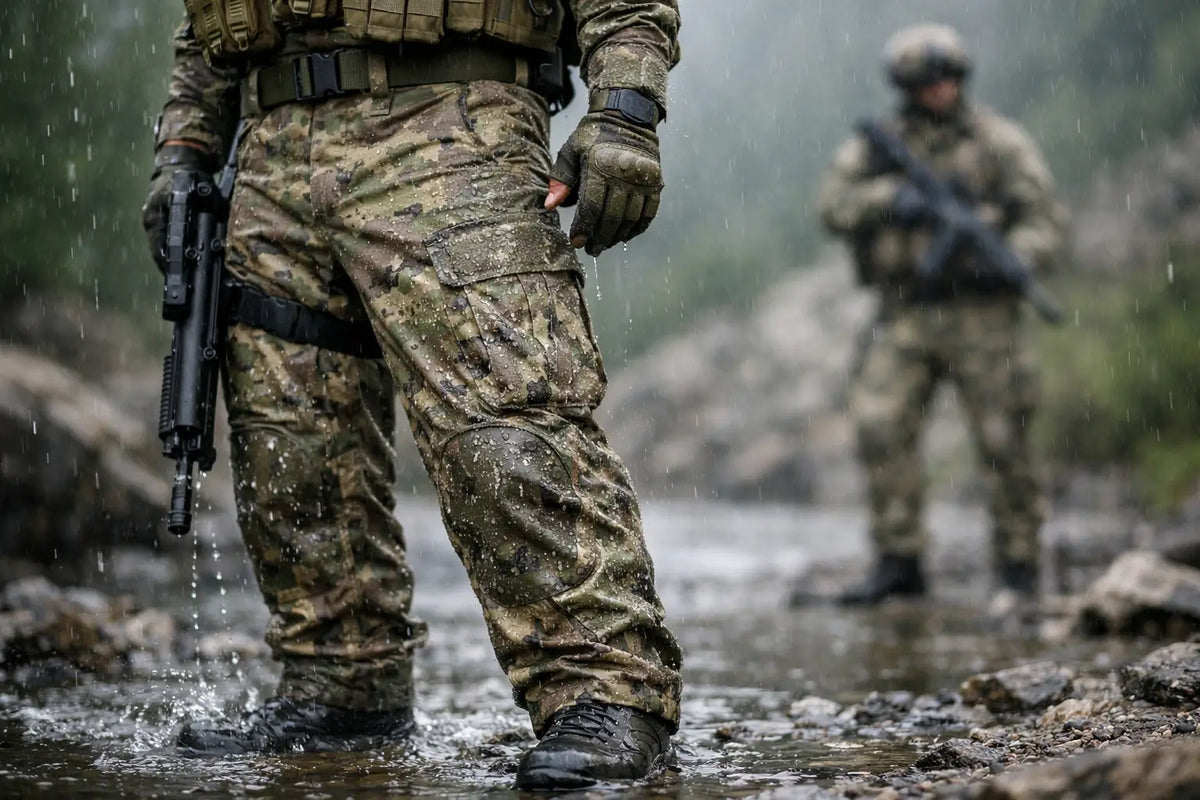
Rain does not stop a range day, a patrol, an exercise or a weekend on the hill. The right military waterproof trousers keep the weather outside while allowing you to move, kneel, carry kit and cover ground without feeling restricted. The wrong pair can leave you damp from condensation, snagging on boots or fighting with overtrousers when time is short.
For service personnel, cadets, police, security users and outdoor enthusiasts, waterproof trousers are not a fair-weather extra. They are a working layer that needs to earn its place in a bergan, vehicle kit bag or day sack. Selecting them comes down to the conditions, the work being done and what is worn beneath them.
Waterproof protection is only part of the job
A waterproof trouser should prevent external rain from soaking through its outer fabric and membrane or coating. That is the baseline, but it is not the whole story. Field use introduces abrasion from kneeling, contact with wet vegetation, repeated movement and the heat generated under a rucksack belt or webbing.
Look first at how the trouser is intended to be used. Lightweight shell trousers suit emergency rain cover, route marching and fast-moving tasks where low weight and pack size matter. A heavier-duty design is often the better choice for prolonged exposure, static duties, fieldcraft or work involving regular contact with rough ground.
Water resistance is not the same as waterproofing. A water-resistant trouser may deal with a shower but can wet through during sustained rain. For all-day wet-weather work, choose properly waterproof construction with sealed seams. These are the points where fabric panels meet, and untreated stitching is a common route for water to enter.
Understanding waterproof ratings
Some waterproof fabrics are sold with a hydrostatic head rating, usually measured in millimetres. In simple terms, a higher figure indicates greater resistance to water pressure. This matters when sitting, kneeling or wearing a loaded pack, as pressure can force water through less capable fabric.
However, do not buy on one number alone. A high rating is useful, but poor seam sealing, weak cuffs or an unsuitable fit can undermine it. Established field brands tend to state the fabric technology, construction and intended use clearly, which is more useful than vague claims of being suitable for all conditions.
Breathability matters when you are working
A waterproof layer traps more than rain. It can also trap body heat and moisture. If sweat cannot escape, the inside of the trousers becomes clammy and it can feel as though the garment is leaking, even when it is technically waterproof.
Breathable membranes help water vapour move outwards while blocking rain from entering. They are particularly worthwhile for tabbing, climbing, route marching, airsoft, dog handling and other active work. They do not remove the need to manage layers, though. Heavy exertion in warm, wet conditions will test any shell trouser.
Ventilation is often as practical as membrane performance. Side zips or venting openings allow excess heat to escape quickly without needing to remove the trousers. Full-length or long leg zips also make it easier to put the shell on over boots, a useful feature when weather closes in halfway through a task.
There is a trade-off. More zips, pockets and adjustment points add convenience, but they also add weight and potential points of wear. A simple, well-made shell is often more dependable for straightforward wet-weather cover. For regular operational use, the extra access and ventilation can justify the complexity.
Choosing the right fit for military waterproof trousers
Most waterproof trousers are designed as overtrousers. They should fit over combat trousers or a base layer without pulling across the seat, knees or thighs. A close fashion fit is no use if it restricts a high step, crouch or kneeling position.
Check the waist adjustment and the cut through the leg. Elasticated waists are quick and comfortable, while a drawcord or belt-compatible arrangement provides more security when carrying equipment. If you expect to wear the trousers over insulated layers in winter, allow room for them. Conversely, excessive spare fabric can catch on vegetation, pedals, equipment and boot hooks.
Leg length needs equal attention. A trouser that rides up over the boot exposes the upper and lets water run into the footwear. One that is too long can be damaged under the heel or become a trip hazard. Adjustable ankle tabs, press studs or zip openings help create a proper seal around the boot while retaining enough room for different footwear.
Try to assess fit in the positions that matter: walking uphill, kneeling, sitting and stepping over an obstacle. Standing still in front of a mirror does not show whether the seat binds or the cuffs climb above the boot.
Features that make a difference in the field
Not every pair needs every feature, but several details are worth looking for when comparing waterproof overtrousers.
- Taped seams prevent rain passing through stitched construction lines.
- Reinforced knees and seat panels offer better durability for kneeling, sitting and rough terrain.
- Long side zips make changes over boots quicker and improve ventilation during movement.
- Adjustable ankle closures reduce flapping fabric and help keep rain, mud and wind out.
- Accessible pockets or pass-through openings allow access to trouser pockets beneath without removing the waterproof layer.
- Quiet face fabric is useful for fieldcraft, stalking and wildlife work, where noisy shells can be a disadvantage.
Colour and pattern should reflect the role. Olive, black and plain earth tones suit a wide range of military, security and outdoor tasks. Camouflage may be appropriate for field use, airsoft or cadet activities, but it should complement the rest of the clothing system rather than being chosen for appearance alone.
Match the fabric to the conditions
For intermittent rain and mild temperatures, a lightweight packable shell is hard to beat. It occupies little space in a rucksack and can be deployed quickly. This is a sensible option for commuting, travel, training areas and days where the forecast is unsettled rather than relentlessly wet.
For exposed ground, winter exercises and long periods outdoors, a more substantial waterproof fabric offers greater confidence. It will usually be heavier and less compact, but it should withstand repeated use better. The extra material can also provide some protection from wind, though waterproof trousers are not a replacement for suitable thermal layers.
In very wet environments, consider the whole system. Water can enter through the waistband, run down from a jacket, or come in over poorly matched boots. A longer waterproof jacket, properly adjusted cuffs and dependable footwear work with the trousers to keep you dry. No single item can compensate for gaps elsewhere in the setup.
Care keeps waterproof kit working
Mud, oils, detergent residue and general field grime reduce the performance of waterproof fabrics. When the outer face fabric stops shedding water, it can become saturated. The membrane may still be keeping rain out, but breathability falls and the garment feels cold and damp.
Follow the care label rather than relying on standard laundry habits. Avoid fabric softener, as it can affect the water-repellent finish. Clean the trousers when needed, rinse them properly and reproof them with a suitable treatment when rain no longer beads on the outer surface.
Before packing them away, inspect the cuffs, seat, knees, seam tape and zip pulls. Small problems are easier to deal with before an exercise or wet shift than when the weather has already turned. Store waterproofs dry, not compressed at the bottom of a kit bag for months.
Build a wet-weather layer you will actually use
The best waterproof trousers are the pair you can put on quickly, move in confidently and trust when the ground is wet and the task still needs doing. Prioritise proven waterproof construction, a fit that works over your normal field layers and features suited to how you operate.
A lightweight emergency shell may be enough for one user; another may need reinforced, breathable overtrousers for regular field use. Choose for the conditions you genuinely face, maintain the fabric properly, and your wet-weather layer will be ready when a dry day becomes a wet one.