
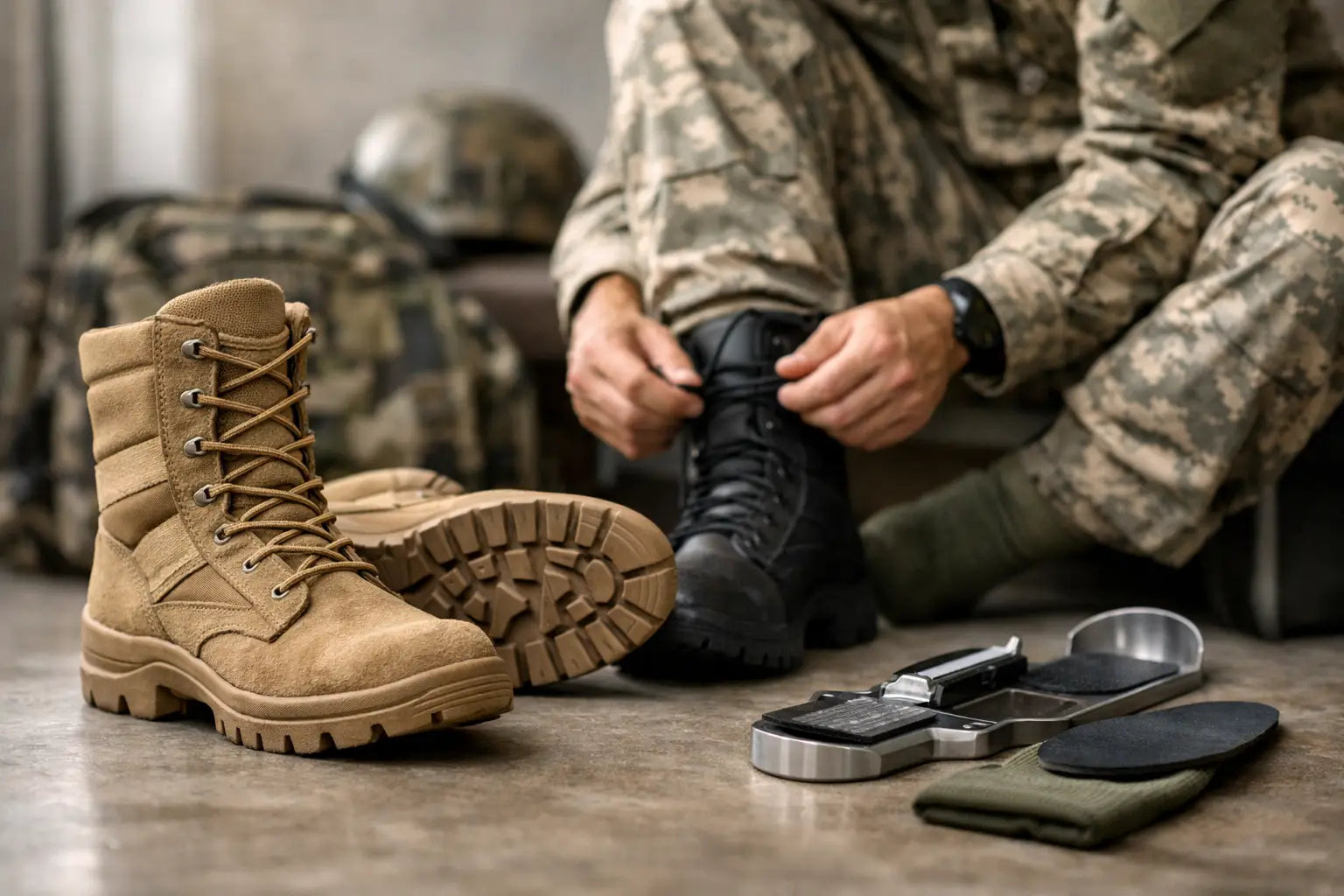
A boot that feels acceptable on a carpeted floor can become a problem after a loaded tab, a full patrol shift or a wet day on uneven ground. This military boot sizing guide covers the checks that matter before you commit to a pair: foot length, width, volume, sock choice and the way the boot holds your heel under movement.
The right size is not simply the number printed on the box. Military and tactical boots are built on different lasts, with different toe shapes, ankle support and insulation levels. A UK 9 in one make may feel noticeably narrower, longer or deeper than a UK 9 in another. Treat the stated size as a starting point, then assess the fit properly.
Start with an accurate foot measurement
Measure both feet at the end of the day, when they are at their largest. Standing with your weight through the foot, place a sheet of paper against a wall, put your heel lightly against it and mark the furthest point of your longest toe. Measure from the wall edge to the mark. Repeat for the other foot.
Use the measurement from your larger foot when checking a manufacturer’s size chart. It is common for one foot to be slightly longer or broader. Buying for the smaller foot usually creates pressure at the toe box on the larger side, which is exactly where blisters, bruised toenails and numbness begin.
Length alone does not decide the fit. Note whether your foot is narrow, standard or broad, and whether you have a high instep. A high-volume foot can feel cramped across the top even when the toe length is correct. Conversely, a low-volume foot may move inside a roomy boot unless lacing and insoles are adjusted.
Measure in the socks you will wear
Try boots with the socks you intend to use on duty, exercise or the hill. A thin synthetic sock, a standard issue-style boot sock and a thick merino pair each take up different amounts of space. If you expect to wear a liner sock beneath a heavier outer sock in cold conditions, test with that exact combination.
Do not size up automatically for thick socks. Going too large can allow heel lift and foot movement, both of which create friction. The aim is adequate room around the foot with a secure heel, not an oversized boot packed out with socks.
What a correct military boot fit feels like
Put the boot on fully, lace it from the forefoot upwards and stand before judging it. Your heel should sit back in the heel cup without being forced hard against it. At the front, you need a small amount of clearance between your longest toe and the toe box - roughly a finger’s width is a useful field check, though foot shape and boot construction can alter what feels right.
Walk on a firm surface, then try a few controlled movements. Step up and down if possible, bend at the knee, and walk downhill on an incline. Your toes should not strike the front of the boot on descent. The heel should remain planted with only minimal movement. A little initial stiffness around a new leather collar is normal; repeated heel lift is not something to break in.
Pay attention to pressure points straight away. Pinching across the little toe, a hard edge over the instep or a seam pressing into the ankle will rarely improve enough to justify keeping the boot. Leather can soften and mould modestly to the foot, but it will not turn a narrow last into a wide one.
Check width and volume separately
Width is the side-to-side room across the forefoot. Volume is the vertical room over the top of the foot and around the instep. They are often confused.
If the sides of your foot bulge over the insole or feel compressed around the ball of the foot, look for a broader fit rather than moving up a full size. Extra length does not solve a width issue and can leave the boot unstable. If the boot feels tight over the laces but the width is comfortable, you may need a lower-volume sock, a different lacing method or a boot designed with more instep room.
For a foot that feels loose in a correctly sized boot, first make sure the laces are properly tensioned through the midfoot and ankle. A suitable insole can take up a little spare volume and improve support. It should not be used to rescue a boot that is plainly too large.
Sizing varies by boot type and construction
Lightweight patrol boots tend to feel more trainer-like underfoot, but they can still have a close, supportive fit through the heel and midfoot. They suit users who cover ground quickly, work long shifts or need less weight on the foot. A close fit should still leave toe room for downhill movement and swelling.
Leather combat boots often have a firmer structure and may feel less forgiving out of the box. They need a secure fit at the heel and ankle, particularly when carrying weight. Some all-leather models will give slightly over time, especially across natural flex points, but they should never require painful wear to reach a usable fit.
Waterproof membrane boots deserve particular care. A membrane adds a layer inside the upper and may make the boot feel warmer or marginally closer than a similar non-waterproof model. In cold, wet conditions that protection is valuable; in warm weather, moisture management and sock choice become more significant. Do not assume a waterproof version will fit identically to a non-waterproof equivalent.
Insulated winter boots can also need a little more internal room because of their lining and the heavier socks commonly worn with them. For ordinary three-season use, excess space can make them feel cumbersome. Match the boot to the conditions rather than trying to make one pair cover every job.
Use lacing to fine-tune, not disguise, the fit
Lacing changes how a boot holds the foot, particularly around the heel and instep. If your heel lifts slightly, tighten the laces through the ankle hooks while keeping the forefoot comfortably secure. If you have a high instep, avoid over-tightening the lower eyelets and use the upper section to lock the heel in place.
Laces should be firm enough to prevent movement, but not so tight that they cause tingling, numbness or pressure across the top of the foot. Recheck them after ten to fifteen minutes of walking. New boots and new laces settle, and a fit that was secure at first may need a small adjustment.
Do not use aggressive lacing to force an unsuitable shape onto your foot. If loosening the laces is the only way to avoid pain, or tightening them is the only way to stop the heel moving, the last is probably wrong for you.
Break in boots before relying on them
A sensible break-in period is part of the military boot sizing process, especially with leather or more supportive combat models. Wear the boots indoors first, then for short local walks with your usual socks. Build distance and load gradually, checking for hot spots after each outing.
Keep the leather clean and conditioned with a treatment suitable for the boot’s material and waterproof system. Do not soak boots in water, use direct high heat or rely on old methods intended to soften leather quickly. Those approaches can damage adhesives, dry out leather and compromise waterproof membranes.
If a hot spot develops, stop and identify the cause. It may be a fold in the sock, a lace-pressure issue, an insole edge or a mismatch between your foot and the boot. Covering the problem with tape can help for a short period, but it is not a permanent fitting solution.
Common sizing mistakes to avoid
The most frequent error is buying by trainer size without measuring or checking the maker’s guidance. Trainers are often softer, shallower and less structured, so the same nominal size can feel very different in a patrol or combat boot.
Another mistake is testing a boot for only a minute. Stand, walk, bend and simulate downhill travel. Your foot changes position under movement, particularly with a rucksack or duty load. A boot that feels spacious while seated may become tight at the toes once you start descending.
Avoid judging fit in thin everyday socks, then wearing thick boot socks for the first field day. Likewise, do not choose a pair with excessive room because you expect your feet to swell. Well-fitted boots already allow for normal movement and swelling; too much room creates its own friction.
Finally, do not overlook insoles. Replacing a thin factory insole with a thicker supportive model reduces internal volume. If you plan to use orthotics or specialist insoles, take them with you when trying boots on and size around the complete setup.
A properly fitted boot should feel secure rather than restrictive, with enough toe room for descent and no pressure that demands wishful thinking. Take the time to measure, test with the right socks and walk the boot as you intend to use it. Your feet will notice the difference long before the end of the day.