
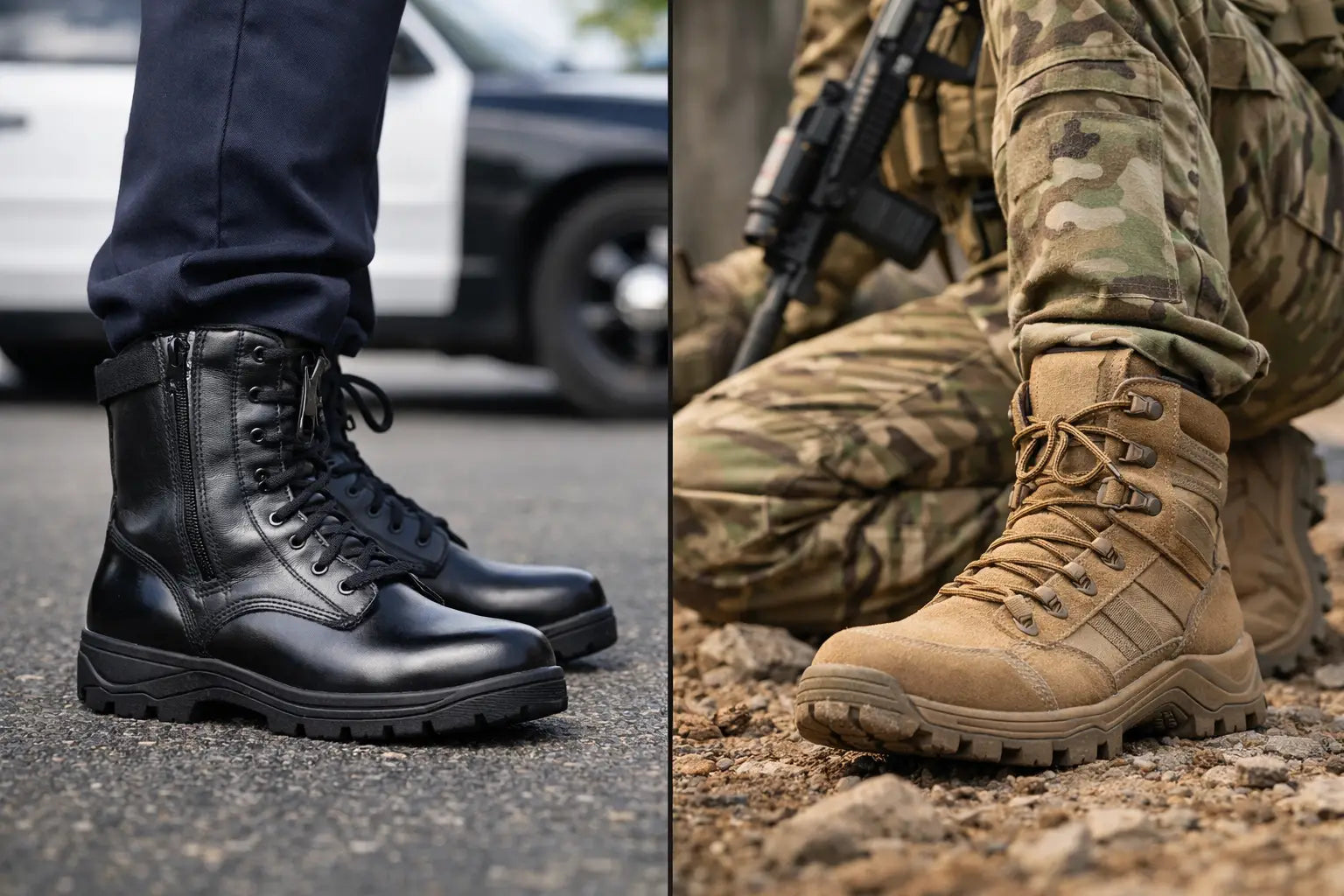
A wet pavement, a long foot patrol and a shift that runs beyond its planned finish will expose poor footwear quickly. The distinction in police boots vs tactical boots matters because the job, uniform requirement and ground underfoot place very different demands on the same pair of feet.
The two categories overlap. Both are built for dependable traction, ankle support and repeated wear, and many modern designs look similar at first glance. The practical difference is usually found in the balance of smart uniform appearance, low-profile mobility, protective features and suitability for rough ground. Choosing well starts with the task, not the label on the box.
What are police boots designed for?
Police boots are generally intended for patrol, response, custody, security and other duties where a professional appearance must sit alongside all-day comfort. They are commonly black, plain in finish and designed to work with operational uniform. A boot may need to remain presentable after walking streets, standing at an incident, climbing stairs and getting in and out of a vehicle repeatedly.
A good police boot normally favours a restrained profile. Smooth leather or a leather-and-fabric upper is easier to clean and polish than heavily textured materials, while black eyelets, understated branding and a neat toe help it meet the expectations of many uniformed roles. That does not mean it is merely a smart boot. Patrol footwear still needs a stable sole, firm heel support and enough flexibility to move naturally when running or kneeling.
Comfort is central. A response officer or security professional can spend most of a shift on hard surfaces, so cushioning and shock absorption often take priority over the aggressive, deep-lug sole wanted for muddy tracks. A lighter boot can also reduce fatigue during vehicle-based work, though too little structure can become a problem when carrying equipment or working long periods on foot.
Individual force, employer and unit policies always take precedence. Some organisations specify approved footwear, while others set a standard for colour, finish, toe protection or ankle height. Check the requirement before buying, particularly if the boot is intended for duty rather than private training or outdoor use.
What are tactical boots designed for?
Tactical boots cover a broader field. They are used by military personnel, security teams, outdoor professionals, airsoft players and anyone needing capable footwear for uneven terrain, load carriage or demanding training. Their design often places more emphasis on grip, durability and support over mixed ground than on maintaining a parade-ready finish.
Many tactical models use suede, fabric panels or hard-wearing synthetic materials. These reduce weight, improve breathability and dry faster than a full leather upper in some conditions. The trade-off is appearance: a fabric and suede boot may be excellent in the field but less suitable where a highly polished black finish is expected.
Sole patterns are often more pronounced, with lugs designed to shed mud and bite into loose earth. A stiffer midsole can reduce foot fatigue when carrying a pack or moving over stones and rutted ground. Tactical boots may also be available in coyote, brown, olive or camouflage-compatible colours, as well as black. That range makes them useful across field roles, but it can rule them out for certain police or corporate uniform standards.
“Tactical” is not a guarantee of a particular protection level. Some boots include protective toe caps, penetration-resistant midsoles, waterproof membranes or heat-resistant outsoles; others are deliberately lightweight and unlined for speed and ventilation. Read the specification rather than assuming every tactical boot offers the same features.
Police boots vs tactical boots: the practical differences
The clearest difference is the intended operating environment. Police boots are usually optimised for urban patrol and a professional uniform standard. Tactical boots are more often optimised for field movement, variable terrain and hard use. There are exceptions, and a quality black tactical boot can be an excellent patrol option if it meets the relevant dress and safety requirements.
Appearance and uniform compliance
Police footwear is commonly expected to be plain black, clean and discreet. Smooth leather uppers offer the easiest route to a polished appearance, while matt leather provides a less reflective alternative that still cleans well. Side zips can speed up fitting, but they must be protected and sufficiently durable for the job.
Tactical boots may have fabric side panels, coloured stitching, exposed webbing loops or a more aggressive sole. None of these details makes a boot inferior, but they can make it unsuitable for a formalised uniform. For ceremonial, public-facing or tightly specified roles, smart finish often carries more weight than a marginal saving in weight.
Ground grip and sole shape
Hard, wet paving demands a sole compound that grips reliably without feeling unstable on smooth indoor floors. Patrol boots tend to use tread patterns suited to streets, station floors and vehicle pedals. Deep, widely spaced lugs are not automatically better here: they can carry debris, feel less precise on hard ground and wear more quickly on abrasive pavement.
For woodland, training areas, loose gravel and wet grass, a tactical outsole generally has the advantage. Deeper lugs and a more supportive platform improve confidence when the ground is soft or irregular. If your work moves between town centres and rural ground, seek a versatile sole rather than choosing the most aggressive pattern available.
Support, flexibility and load carriage
A higher-cut tactical boot can offer useful ankle control when walking with a rucksack, wearing body armour or crossing uneven ground. A supportive shank and firmer midsole protect the foot from repeated flexing over rough surfaces. The compromise is that a stiff boot takes longer to break in and may feel cumbersome for driving or fast movement on level ground.
Police boots commonly aim for a more forgiving feel from the first shift. They may flex more readily through the forefoot and use cushioning that suits concrete and tarmac. That can be the better choice for a long patrol route, but a soft sole is less capable when carrying heavy loads over broken terrain. Match the support to what you actually carry, not to the most demanding task you might face once a year.
Weather management and maintenance
Waterproof membranes are valuable for rain, standing water and wet grass, but they can run warmer during summer shifts. A breathable, non-waterproof tactical boot can be more comfortable in dry conditions and will often dry more readily after a full soaking. Neither option works well without suitable socks: use technical socks that manage moisture and avoid bulky seams around the toes.
Leather police boots need cleaning, conditioning and, where required, polishing to prevent the upper drying out or cracking. Tactical fabric boots need mud brushed away and should be dried naturally, away from direct heat. For both types, remove insoles after a wet day and allow the boot to dry fully before the next wear. A damp boot becomes uncomfortable quickly and shortens the life of the materials.
How to choose the right pair
Start with the conditions of your normal week. A response officer working mostly urban shifts may be better served by a smart black patrol boot with dependable cushioning. A security professional moving around industrial sites may need more underfoot protection. Cadets, reservists and outdoor users covering rough ground will often benefit from a tactical boot with a supportive chassis and terrain-focused outsole.
Before committing, check five practical points:
- Your employer's rules on colour, finish, boot height and safety certification.
- The ground you cover most often, rather than the occasional extreme condition.
- Whether you spend more time walking, standing, driving or carrying weight.
- The space available around the toe box when wearing your normal duty socks.
- The break-in period required before the boot is ready for a full shift or exercise.
Do not assume a larger size is the answer to a narrow fit or pressure point. Different brands use different lasts, and width, heel hold and instep volume vary significantly. A properly fitted boot in the right style will outperform a more expensive model that does not suit your foot shape.
When one boot can cover both roles
For many users, a plain black tactical boot is the sensible middle ground. Look for a clean upper, moderate ankle height, a sole that grips wet hard surfaces as well as loose ground, and enough structure for occasional load carriage. This approach suits security work, training, airsoft and outdoor use where a smart black appearance is useful but formal polish is not essential.
For strict police presentation, regular urban duty or public-facing work, a dedicated police boot remains the stronger choice. For extended field exercises, rural work and heavy equipment, a dedicated tactical boot is usually worth the extra support and terrain capability. John Bull Clothing’s specialist boot range is best approached with those operating conditions firmly in mind.
The right boot should disappear from your attention once the shift gets busy. Choose the pair that meets your policy, fits your actual workload and gives your feet the support to keep moving when the ground, weather and hours turn against you.