
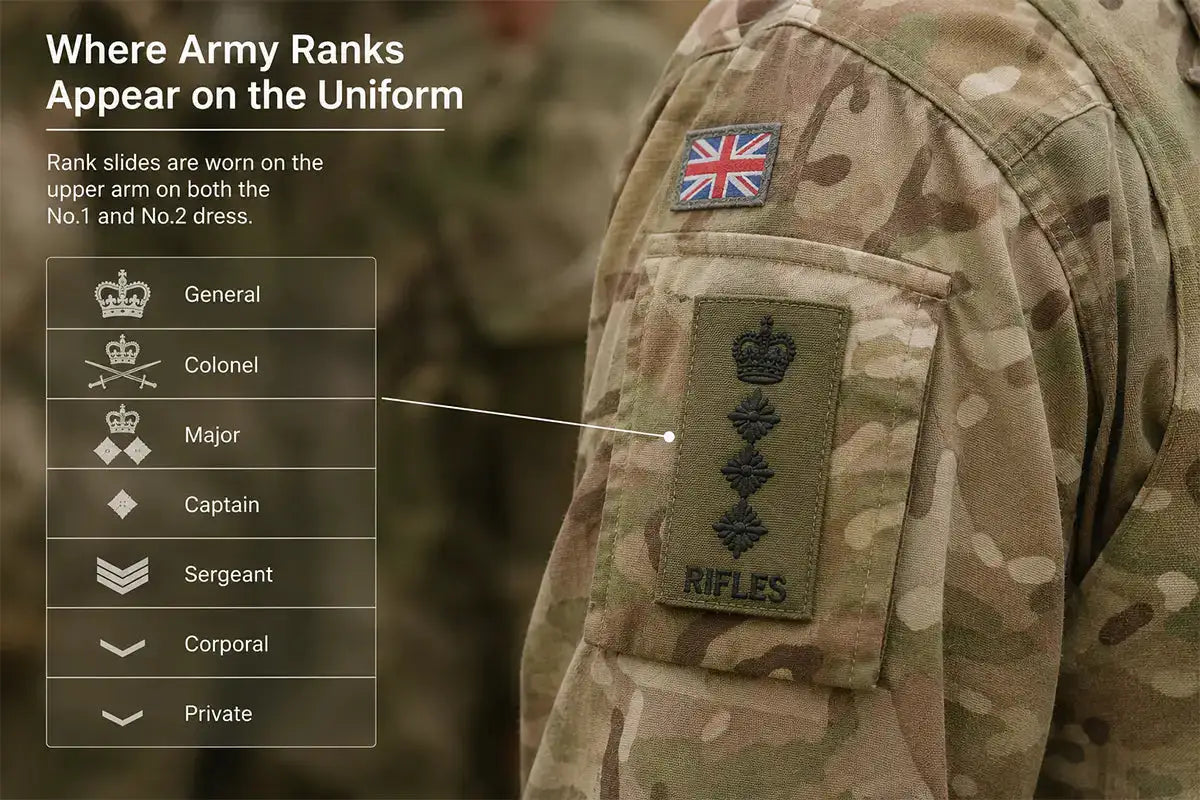
If you have ever looked at a uniform listing and paused over the question, what are rank slides, the short answer is simple. They are removable fabric insignia worn on the shoulders or chest tabs of certain uniforms to show rank clearly and correctly. In practice, they matter because they help identify appointment, authority and role at a glance, while allowing the same garment to be used as rank changes.
That makes rank slides a practical bit of kit rather than a decorative extra. For serving personnel, cadets, veterans assembling display uniforms, and families buying regiment-related items, getting the right slide is part of getting the uniform right. A poor match stands out immediately. The correct one keeps presentation sharp and avoids confusion.
What are rank slides on a uniform?
Rank slides are usually fabric sleeves or slip-on tabs carrying rank markings. They are designed to fit over shoulder straps or onto specific uniform attachment points. You will commonly see them in olive, black, navy or other service-appropriate colours, with insignia embroidered or printed to match the dress requirement.
Their main purpose is flexibility. Instead of sewing rank permanently onto every shirt, smock or jumper, the wearer can move the rank slide between compatible items. That saves time, keeps costs down and makes replacement easier when promotion, transfer or role changes happen.
This is one reason they are widely used across military and cadet settings. They are straightforward, visible and easy to swap. In units where uniform standards are taken seriously, that convenience matters.
Why rank slides are used instead of fixed badges
A fixed badge has its place, particularly on formal dress and specialist uniforms, but rank slides suit working kit well. Field shirts, PCS-style clothing, jumpers and some outer layers are expected to be practical first. A removable insignia system fits that requirement.
There is also less commitment in the garment itself. If a shirt wears out, the rank slide stays. If a soldier, cadet or staff member needs to update insignia, the uniform does not need altering by hand. For training establishments, cadet forces and anyone managing several uniform items, that is simply more efficient.
The trade-off is that they only work where the garment has been designed to take them. Not every jacket or shirt is compatible. Before buying, it is worth checking whether you need a slip-on shoulder slide, a chest rank tab or another format entirely.
Where rank slides are worn
Most people picture rank slides on the shoulders, and that is often correct. They slide over epaulettes or shoulder straps so the insignia sits flat and faces outward. This placement keeps rank easy to read without interfering with webbing, body armour or equipment more than necessary.
On some garments, especially newer working dress systems, rank may sit on the chest instead. That can be a better option when body armour or smocks cover the shoulders. In those cases, the item may still be described broadly as a rank slide by shoppers, even if the attachment method differs slightly.
It depends on service branch, dress regulations and the garment itself. Army-style clothing, cadet uniforms and surplus items are not all identical. The safest approach is to match the insignia format to the exact uniform being worn, not just the rank.
What information a rank slide shows
At its most basic, a rank slide displays rank. That may be done through stripes, crowns, pips, crossed swords, chevrons or other recognised insignia, depending on service and appointment. Some slides also include wording such as CADET, unit identifiers or branch distinctions where permitted.
This is where detail matters. A rank insignia can look simple, but small differences in colour, stitching, proportion and backing cloth can separate the correct item from an unsuitable one. For someone on parade, on exercise or attending a formal cadet event, those details are not minor.
Buyers also need to separate rank from other identifiers. A formation sign, tactical recognition flash or regimental patch is not the same thing as a rank slide. They may be worn in the same general area of the uniform, but they serve different purposes.
What are rank slides for cadets?
If you are asking what are rank slides in a cadet context, the answer is much the same, but the buying decision is often more specific. Cadet forces use rank slides so cadets and adult instructors can be identified clearly during training, parade nights, camps and ceremonial occasions. They support uniformity, chain of command and standards of dress.
Cadet buyers also tend to replace items more often. Promotions are common, younger cadets outgrow uniform quickly, and dress requirements can vary between ordinary unit nights and more formal events. A removable slide system is practical for both parents and staff because it avoids repeated sewing and alteration.
The main point to watch is compatibility with the relevant cadet force and dress policy. Army Cadet Force, Combined Cadet Force sections and other organisations may use slightly different conventions. Do not assume one slide suits all uniforms simply because the rank title is the same.
Choosing the right rank slides
The right choice starts with three checks: service or organisation, garment type and rank. Get those right first. A slide that carries the correct insignia but fits the wrong shoulder strap is no use, and a slide in the wrong cloth colour can look immediately out of place.
Material and finish come next. Better slides hold shape well, sit neatly and retain a smart appearance after regular wear. Poorer ones may fray, curl or fade, especially if they are being moved between shirts and jumpers. For daily use, that difference shows up quickly.
There is also the question of use case. If the slide is for routine training wear, practicality matters most. If it is for inspection, parade or a presentation uniform, appearance carries more weight. Often the best option is not the cheapest one, but the one that matches the intended uniform properly and stands up to use.
Common mistakes when buying rank slides
The most common mistake is buying by rank title alone. Sergeant, lieutenant or cadet ranks may exist across different settings, but the insignia style and background can still vary. Always buy to the uniform specification, not just the wording.
Another regular issue is mixing dress standards. A slide intended for one order of dress may look wrong on another. This is especially relevant for buyers piecing together kit from several sources, including surplus and newer issue-style garments.
Size and fit are often overlooked as well. If a rank slide is too loose, it can twist or sit unevenly. If it is too tight, it may not sit flat or may be difficult to fit at all. Product dimensions and intended use are worth checking before ordering.
Finally, there is confusion between genuine service-style presentation and costume-grade items. For anyone who values authenticity, that difference matters. Proper military-style kit should look the part, wear properly and suit the garment it is meant for.
Rank slides for serving personnel, collectors and gift buyers
Not everyone buying rank slides is wearing them day to day. Some customers are replacing missing insignia on stored uniform, building a display, or completing a regimental gift item with correct detail. In those cases, accuracy still matters.
Collectors and gift buyers often focus on visual correctness, while serving personnel and cadets need a balance of correct appearance and practical wear. Neither approach is wrong. The key is knowing the purpose before you buy.
That specialist understanding is where a military outfitter has an advantage over a general clothing retailer. A broad range is useful, but category knowledge is what helps buyers avoid ordering the wrong insignia for the wrong garment.
Caring for rank slides
Rank slides are small items, but they benefit from sensible care. Keep them dry, store them flat where possible, and avoid crushing them into overfilled kit bags. If the garment is being washed, remove the slide first unless the care instructions clearly allow otherwise.
Embroidery and printed detail can both suffer from rough handling. Mud, repeated folding and snagging on hook-and-loop surfaces will shorten their life. If you rely on them regularly, it makes sense to keep a spare set in your kit.
For cadets and families, this is especially useful. One missing or damaged slide can leave an otherwise complete uniform unserviceable for parade.
Rank slides are a small part of uniform, but they carry real weight. They show where someone stands, help maintain standards and make it easier to keep working dress current as roles change. If you buy them with the same care you would give to boots, webbing or outerwear, you usually get it right first time.