
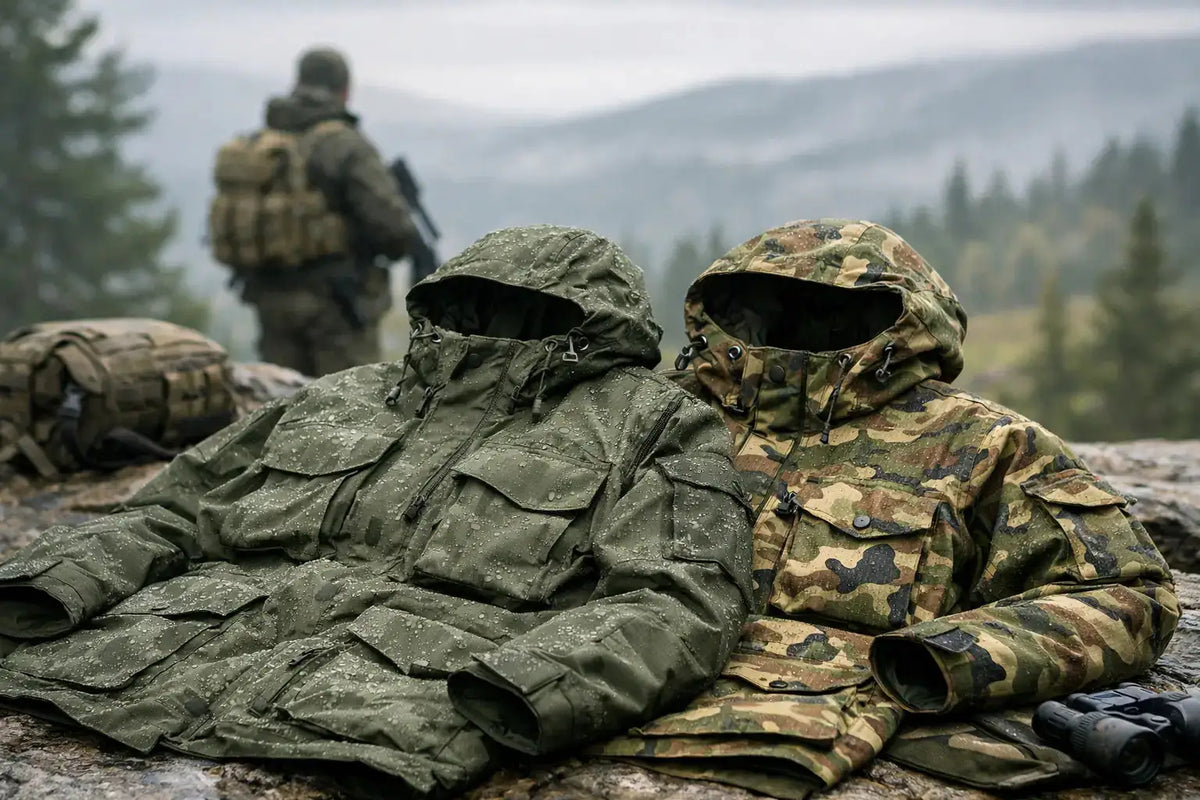
A wet training area exposes poor outer layers quickly. Water runs through untreated seams, hoods block peripheral vision, and oversized jackets snag on webbing. The best waterproof military smocks are not simply the warmest or the most heavily pocketed. They are the ones that keep weather out, work around your load carriage and still let you move, observe and carry out the task.
For serving personnel, cadets, security users and serious fieldcraft enthusiasts, a smock needs to earn its place in the kit locker. This guide sets out what separates a useful waterproof military smock from a jacket that looks the part but falls short when conditions turn.
What Makes the Best Waterproof Military Smocks?
A proper waterproof smock needs more than a water-repellent outer finish. Durable water repellent treatment helps rain bead and run off the face fabric, but the garment's actual waterproof performance comes from its membrane or coating and, crucially, its sealed seams. If seams are not taped, water will eventually find its way through the stitching.
The right construction depends on how the smock will be used. A lightweight shell is sensible for moving quickly on exercise, hill days or wet-weather dog walking, where you need to regulate temperature and carry insulation separately. A more substantial field smock suits static tasks, long patrols and colder seasons, particularly when its cut provides room for a fleece or insulating layer beneath.
Breathability matters just as much as waterproofing. Marching with a bergen, conducting drills or working over uneven ground produces heat rapidly. A fully waterproof fabric that traps perspiration can leave the wearer damp from the inside. Look for practical venting, such as underarm zips or a front zip that can be adjusted, rather than relying on a fabric claim alone.
Fabric and Construction: Read Beyond the Label
Waterproof garments generally use coated fabrics or laminated membranes. Coated options can offer good weather protection at a lower price and are often appropriate for occasional use. Membrane-based shells tend to offer better moisture management and durability, but this depends on the quality of the face fabric, lining and finishing as much as the membrane itself.
A two-layer smock usually combines a waterproof layer with an inner lining. It can be comfortable and hard-wearing for general field use, although it may be heavier and slower to dry. A three-layer construction bonds the face fabric, membrane and inner protective layer together. This normally creates a cleaner, more packable shell with a good balance of protection and breathability, making it a strong choice for repeated hard use.
Do not judge a smock by waterproof ratings alone. A high stated rating is of limited value if the hood is poorly shaped, the storm flap lifts in wind, or the cuffs leave gaps around gloves. Check the details you will use in poor weather: taped seams, covered zips, an adjustable hem, properly closing cuffs and a collar that protects the neck without rubbing the chin.
Smock Fit With Webbing, Body Armour and a Bergen
A military smock should layer comfortably without becoming loose enough to catch on branches, vehicle fittings or equipment. This is where trying the intended system together is worthwhile. Put on the mid-layer you will actually wear, then check the smock with your webbing, chest rig or plate carrier. Raise both arms, shoulder a pack and squat. Restriction in these positions will become more obvious after several hours outdoors.
Length is a trade-off. A longer smock offers better coverage over the seat and upper thigh when kneeling or standing in rain. However, too much length can bunch under a belt kit, interfere with a harness or make access to trouser pockets awkward. A shorter shell works more cleanly with modern load carriage and is usually easier to pack, but gives less coverage during static work.
Pay close attention to the shoulders. Wide, articulated shoulders improve reach when climbing, navigating or handling equipment. They should also sit smoothly under pack straps. Thick seams and bulky pocket flaps under a bergen can become uncomfortable surprisingly quickly.
Hood Design Is Operational, Not Cosmetic
A hood is often the difference between remaining comfortable and spending the day with rain running down your collar. It should adjust at the crown and around the face so it moves with your head rather than obscuring your view when you turn. A stiffened or wired peak helps keep rain away from the eyes, but it should not be so rigid that it catches on vegetation.
Make sure the hood works with the headwear you use. A hood that fits neatly over a cap may feel tight over a warm hat. One designed to accommodate a helmet can be excellent in driving rain, yet overly loose for unhelmeted use unless it has effective adjustment. For field use, a close-fitting, adjustable hood is usually more useful than a large one with no control.
Pockets Must Work in the Rain
Traditional military smocks are valued for their pocket capacity. Map pockets, chest pockets and lower bellows pockets can reduce the need to open a pack for gloves, notebook, compass, rations or a small first-aid item. But pocket layout should match your load carriage, not just provide maximum storage.
Chest pockets are often the most useful when wearing a belt kit, while lower pockets may be blocked by a waist belt or body armour. Large external pockets can also fill with water if their flaps are poorly designed. Covered openings, drainage arrangements and secure closures matter more than sheer volume.
Avoid overloading the smock. Heavy items pull at the fabric, affect balance and make the jacket less breathable beneath a pack. Keep only frequently needed, light kit in the pockets, and secure anything that must not be lost with a lanyard or internal retention point where available.
Choose Camouflage and Colour for the Job
For military-style use, camouflage must be appropriate to the environment and any relevant dress or training requirements. British woodland patterns suit temperate vegetation far better than arid or urban patterns, while plain colours can be the more practical choice for security work, countryside use and daily outdoor wear.
Serving personnel should follow unit direction on approved patterns and garments. For cadet activity, airsoft and civilian fieldcraft, consider where the smock will be used most often. A pattern that blends into winter woodland may stand out against green summer foliage, while a dark solid colour can absorb heat in warmer weather.
At John Bull Clothing, selecting field kit by use case rather than appearance is the sensible approach. Established outdoor and military brands frequently offer different cuts and fabric weights, so compare the garment specification with the conditions you actually face.
A Quick Pre-Purchase Check
Before committing to a waterproof smock, check these practical points:
- Confirm that all critical seams are taped, not merely that the fabric is described as water-resistant.
- Check whether the hood adjusts at both the face and crown, and whether it works with your usual headwear.
- Consider what will sit underneath and over the smock, including insulation, webbing, body armour and pack straps.
- Inspect pocket placement with your intended load-carrying system in mind.
- Decide whether you need a compact shell for movement or a longer, tougher smock for sustained field use.
Care Keeps Waterproof Kit Serviceable
Waterproof clothing needs routine care. Dirt, smoke residue, body oils and detergent residue can prevent the outer fabric from shedding water and reduce breathability. When rain stops beading and the face fabric begins to wet out, the garment may still be waterproof, but it will feel colder and less comfortable.
Wash the smock according to its care label, using a suitable cleaner rather than ordinary household detergent or fabric conditioner. Reproof when necessary with a treatment suited to the garment's fabric and membrane. Low heat may help reactivate some durable water repellent finishes, but only where the care instructions permit it.
Inspect cuffs, hems, zips and seam tape after regular use. Small faults are easier to deal with before a wet exercise or a winter weekend outdoors. Store the smock dry and loosely hung where possible, rather than crushed at the bottom of a bergen for months.
A waterproof military smock is a working layer, not a guarantee against every condition. Match it to your terrain, activity level and load carriage, maintain it properly, and it will be the jacket you reach for when the forecast stops being a forecast and becomes the job.