
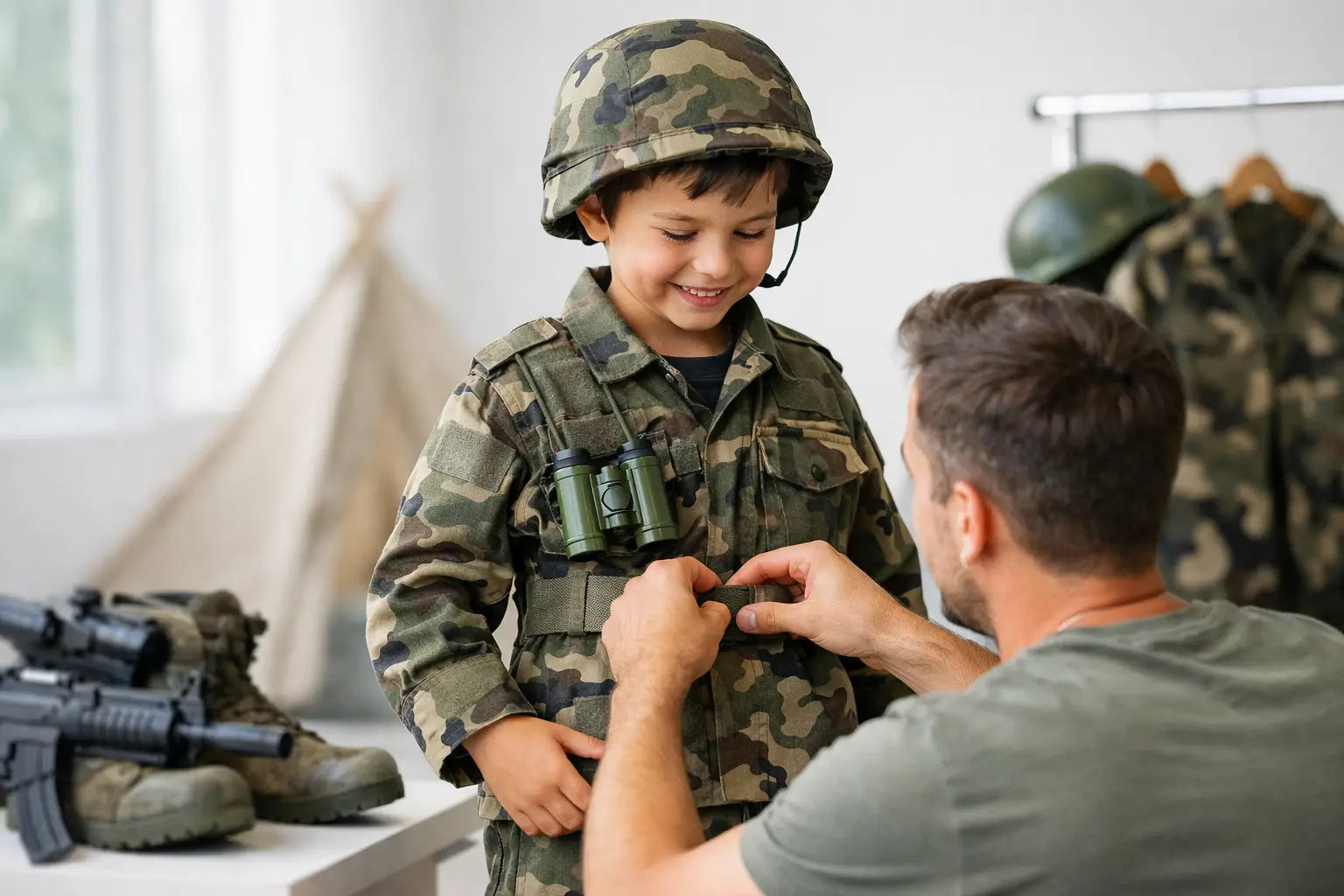
A kids' army costume needs to do more than look the part for a school dress-up day or themed party. It must allow a child to move freely, stay comfortable indoors and out, and suit the occasion without becoming overloaded with unnecessary kit. The best choice is usually a simple, well-fitting camouflage outfit built for play rather than a scaled-down attempt at full field equipment.
For families with military connections, the appeal may be a familiar camouflage pattern, a cadet-inspired look or a respectful nod to service life. For others, it is simply a practical fancy-dress option that copes better with running about than a flimsy one-day costume. Either way, fit, fabric and sensible accessories matter more than trying to add every tactical detail.
Start with the occasion, not the camouflage
A costume for a birthday party has different demands from one worn for World Book Day, a school history activity, a village fete or a cadet-themed event. Schools may have their own guidance on military dress, replica items and face coverings, so check this before buying. A straightforward camouflage jacket and trousers, or a lightweight all-in-one costume, is generally easier to manage than a look built around toy weapons or bulky webbing.
It is worth keeping the presentation age-appropriate. Children do not need rank slides, realistic insignia or equipment designed to imitate operational load carriage. A plain cap, a small name patch if appropriate, or a simple flag patch can give an outfit a finished appearance without making it overcomplicated. Where a family connection to a regiment matters, choose details carefully and respectfully rather than treating formal insignia as party decoration.
For a colder outdoor event, a camouflage smock over ordinary layers can be the most useful option. For a warm hall or classroom, a lighter cotton or polycotton shirt and trousers will be more comfortable. The right choice depends on where it will be worn and how long the child will have it on.
Fit is the first field test
Children rarely stand still at a party. They climb, sit on the floor, run, eat and often wear a coat over their costume on the journey. A kids' army costume should therefore have enough room through the shoulders, seat and knees to allow normal movement.
Avoid buying several sizes too large in the hope of getting extra wear from it. Oversized sleeves can catch on play equipment, trousers can trail under shoes, and loose waistbands make a child uncomfortable. A little growing room is sensible, particularly in a durable camouflage set, but it should still be secure at the cuff, waist and ankle.
Check the product measurements where available rather than relying only on age labels. Children of the same age can differ substantially in height and build. Measure a comfortable pair of trousers from waist to ankle, then compare chest and sleeve length with a shirt or jacket they already wear. If the outfit will be layered over a sweatshirt, allow for that when choosing the size.
Adjustable waists, drawcord hems and cuff fasteners are useful features, provided they are simple for the child to manage. Elasticated waist trousers are particularly practical for younger children. If the child cannot undo the fastenings independently for the toilet, the costume may become a problem halfway through the event.
Boots, trainers and trouser length
Heavy military-style boots may look convincing, but they are not always the right footwear for a child. New boots can rub, weigh more than expected and make running difficult. For most indoor events, clean trainers or sturdy shoes are the sensible option. If boots are required for an outdoor activity, they should already be broken in, have a secure fit at the heel and be worn with suitable socks.
Trousers should sit clear of the ground. Rolled hems can work for a short event, but a proper fit is safer and neater. Never rely on loose laces, dangling belts or long straps to hold an outfit together.
Choose fabrics that can cope with real use
Costume fabric is often where the difference lies between an outfit that lasts an afternoon and one that can be used for camping, airsoft-style supervised play, fancy dress and everyday outdoor wear. Thin polyester can be light and inexpensive, but it may feel clammy and is less forgiving when children are active. Polycotton camouflage clothing is usually a stronger all-round option because it balances durability, breathability and straightforward washing.
Cotton-rich garments feel comfortable against the skin, but they can stay damp longer after rain or spilled drinks. Synthetic-heavy fabrics dry faster and often resist creasing, though some children find them warmer indoors. For UK weather, layers usually solve the problem better than choosing an overly thick costume. A T-shirt beneath a lightweight camouflage top gives flexibility if a hall is warm or an afternoon turns chilly.
Look for reinforced stitching at the knees, seat and pockets if the item will see repeat use. Functional pockets are helpful for a packet of tissues or a snack, but large cargo pockets can become a dumping ground for small toys. Before leaving home, check that zips run smoothly and that buttons, hook-and-loop tabs and drawcords are securely attached.
At John Bull Clothing, families can find camouflage clothing with a more practical, field-inspired build than typical disposable fancy dress. That makes particular sense where the outfit is likely to be worn again for camping, cadets or outdoor play.
Camouflage patterns and colours
The exact camouflage pattern is less important than many buyers assume. For young children, the priority is a coordinated, presentable outfit in colours that suit the event. Woodland-style greens and browns are a familiar choice for outdoor parties and activities, while desert tones can work well in warmer weather or for a more distinctive look.
Try not to mix several unrelated camouflage patterns in one outfit unless there is a deliberate reason for doing so. A camouflage jacket with plain olive, black or khaki trousers often looks cleaner than competing prints from head to toe. Conversely, a matching shirt and trouser set is easy to buy, easy to wear and gives a recognisable military-inspired appearance without extra accessories.
Avoid face paint that significantly obscures a child's features, especially at school events. If face paint is permitted, a small amount of washable green and brown can be enough. Test it on a small area of skin first, and keep wipes to hand for removal.
Keep accessories useful and safe
Accessories can quickly turn a sound outfit into an awkward one. The aim is to add character without restricting movement, vision or hearing. A lightweight cap or beret can be effective, but it should fit securely and be removed if it becomes distracting during games. A child who constantly adjusts headwear is unlikely to enjoy wearing it.
Small day packs are best kept light. A water bottle, snack, spare layer and waterproof are more than enough for an outdoor event. Large rucksacks, heavy belts and adult-sized webbing can pull on the shoulders, snag on doors and make sitting difficult. If a prop is allowed at all, choose something clearly toy-like, soft and suited to the organiser's rules. Many events are better without one.
Do not add sharp badges, metal tools, carabiners, survival knives, real radios or other adult field accessories. These items may be useful kit in the right setting, but they do not belong on a child's fancy-dress outfit. The same applies to loose patches and badges that could be swallowed by younger siblings.
Prepare the outfit before the day
Do a full trial run at home. Ask the child to sit, bend, reach overhead, climb a few stairs and put on their outer coat. This quickly exposes tight shoulders, slipping trousers and footwear that rubs. Wash the garment according to its care label before first use if it has a factory finish or noticeable storage smell.
Pack a plain spare top for longer events, particularly where food, paint or wet weather are involved. If the costume includes a cap, label it inside. Children often put identical items down together, and a labelled garment has a far better chance of returning home.
A well-chosen costume should leave a child free to take part rather than feeling dressed up by their kit. Keep it comfortable, keep it safe, and choose pieces sturdy enough that the next adventure does not require starting again from scratch.