
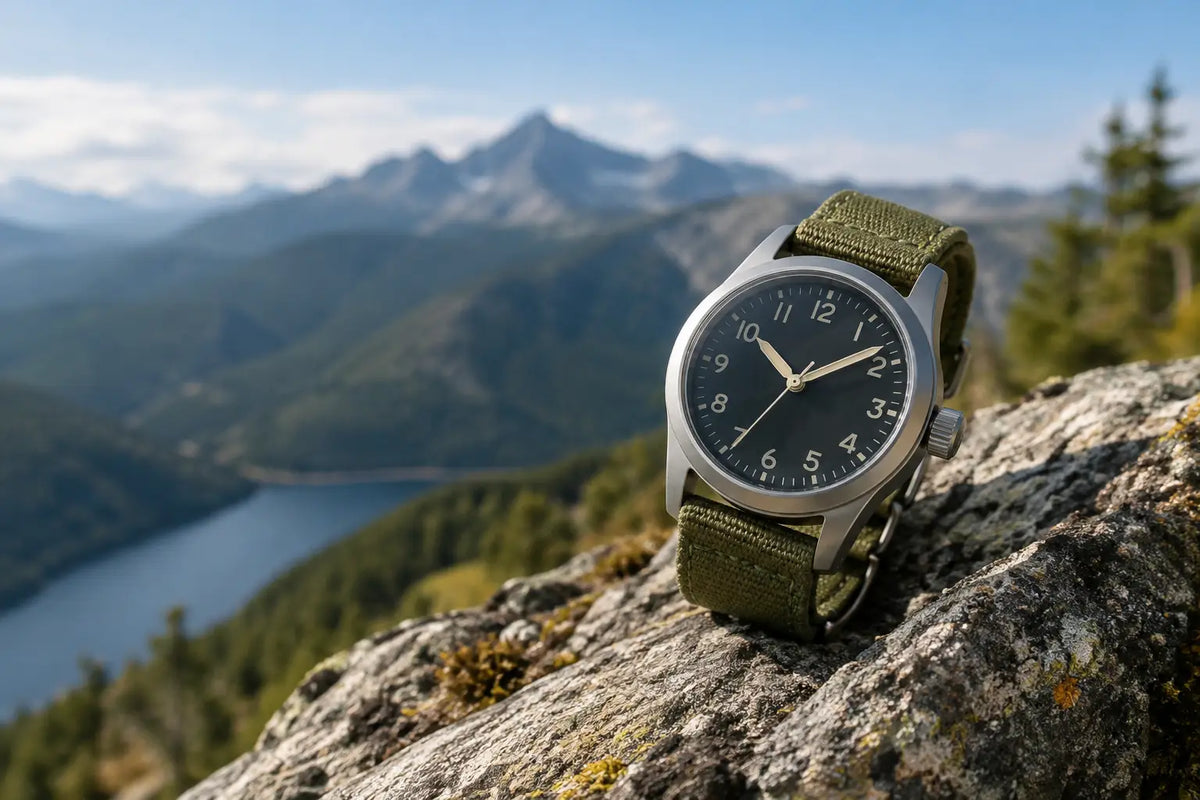
A watch is still useful when batteries are low, a handset is packed away, or gloves make touchscreens awkward. The best field watches do one job without fuss: give you the time immediately, in poor light and under hard use. That sounds simple, but dial layout, movement, strap and case material all affect whether a watch remains useful after a wet day on the hill, a long shift, or a weekend in the field.
For military personnel, cadets, security staff and outdoor users, the right choice is usually not the biggest or most feature-heavy model. It is the one you can read at a glance, wear comfortably for hours and trust not to become another item of kit demanding attention.
What Makes a Watch a Field Watch?
A field watch has its roots in military timepieces designed for practical use. Its defining features are generally a clear, high-contrast dial, Arabic numerals, luminous hands and markers, a straightforward case and a secure strap. Many models use a 24-hour scale on the dial or an inner ring, which can be useful for anyone accustomed to 24-hour time.
The category is broad. Some field watches are compact, simple quartz watches with fabric straps. Others are heavier-duty models with sapphire crystal, screw-down crowns, substantial water resistance and tritium illumination. They are not all intended for the same role, so it pays to match the specification to the job rather than buying on appearance alone.
A good field watch should remain legible when you are tired, moving, wet or working in low light. Decorative sub-dials, glossy finishes and overly busy displays can look impressive but may slow down that first read of the time. Function comes first.
Choose the Right Movement for the Task
The movement is the mechanism that keeps time. For field use, the main choice is between quartz and mechanical.
Quartz: accurate and low-maintenance
Quartz watches run from a battery and are normally the practical choice for users who need accuracy with minimal upkeep. They tend to be more affordable, tolerate knocks well and can be left in a kit drawer or worn daily without needing regular adjustment. A battery change is the main maintenance requirement.
For operational, security and general outdoor use, quartz has a clear advantage: it is accurate enough that you are unlikely to need to think about it. If timing needs to align with a team, transport, an exercise serial or a shift handover, that consistency matters.
The trade-off is battery dependency. This is rarely a serious issue if the watch is serviced sensibly and the battery is changed before it fails, but it is worth considering for extended trips away from support.
Mechanical: traditional, but requires attention
Mechanical field watches are powered by a mainspring, either wound by hand or charged through wrist movement. Many people value their engineering, heritage and ability to run without a battery. They can also be a sound choice for those who want a watch to keep for years rather than replace.
However, mechanical watches are generally less accurate than quartz and need more care. A hard impact can affect timing, and automatic models may stop if not worn regularly. For everyday field use, that does not make them unsuitable, but it does make them a deliberate choice rather than the obvious one.
Readability Matters More Than Extra Functions
The dial is where a field watch earns its place. Black or dark dials with white markings are a common and sensible choice, while a pale dial with dark numerals can be equally effective in daylight. The key is contrast. Hands should stand apart clearly from the dial and from each other.
Look for numerals or hour markers large enough to read quickly, along with minute markings that are not obscured by unnecessary design details. A date window is useful for routine work and travel, but only if it does not compromise the layout. For many users, a simple three-hand watch is the most dependable format.
Low-light performance deserves proper attention. Standard luminous paint needs exposure to light before it glows and will fade through the night. This is adequate for most general use. Tritium tubes glow continuously without charging, making them particularly useful for night work, but they often cost more and the illumination has a finite service life.
Do not confuse bright lume with light discipline. A highly visible watch face may be useful for personal reference, but any light source can be a consideration in a tactical environment. Follow unit procedure and use sensible judgement for the task.
Case Size, Crystal and Water Resistance
A field watch should sit securely under a cuff and not catch on webbing, gloves or equipment. Case sizes around 36 mm to 42 mm suit many wrists, though fit matters more than a number on a specification sheet. A smaller watch is often more comfortable under layers and less likely to get knocked. A larger dial can be easier to read, especially with gloves or ageing eyes.
Case material is usually stainless steel, resin or titanium. Steel offers proven durability and a solid feel. Resin is light, affordable and well suited to hard, wet use. Titanium reduces weight and resists corrosion well, although it can cost more and may show surface marks differently from steel.
The crystal protects the dial. Acrylic is inexpensive and can be polished after light scratches, but it marks more easily. Mineral glass is common and offers reasonable everyday protection. Sapphire is highly scratch-resistant and is the preferred option for many long-term users, though a severe direct impact can still damage it.
Water resistance is often misunderstood. A watch marked 30 metres is generally suitable for splashes, not swimming. For regular wet-weather use, washing kit or working around water, 100 metres is a more reassuring standard. If swimming, watersports or repeated immersion are part of the plan, choose accordingly and ensure the crown is fully secured.
Straps Are Working Parts of Field Watches
A strong watch on a poor strap is not dependable kit. The strap affects comfort, security and how easily the watch can be cleaned after mud, sweat or saltwater.
Nylon web straps are light, quick-drying and easy to replace. A pass-through design can provide extra security because the watch remains attached if one spring bar fails. They also suit field use well, although wet nylon can stay damp against the wrist for a while.
Rubber or silicone straps are suitable for wet conditions and wipe clean easily. Choose a quality version with a secure buckle, as cheaper straps can feel stiff or deteriorate over time. Leather looks traditional and works well for daily wear, but it is less suited to prolonged wet weather or repeated hard use. Metal bracelets are durable, though heavier and less forgiving in cold conditions.
Whatever material you choose, check the spring bars and buckle regularly. A watch lost in long grass, on a range day or during a tab is rarely recovered.
Useful Features, and Features You May Not Need
A rotating bezel can help track elapsed time for navigation checks, rest periods, cooking, medication or shift tasks. A compass bezel offers basic directional assistance when used correctly, but it is not a replacement for a proper compass and sound navigation skills. Alarm functions, timers and dual-time displays can also be useful, particularly for travelling or irregular shift patterns.
GPS, digital mapping and fitness data may be valuable in a dedicated outdoor or tactical watch. The compromise is battery consumption, a more complex interface and usually a larger case. For some users, those features justify the extra bulk. For others, a simple analogue watch alongside a separate navigation device is more reliable and easier to manage.
If you are serving, check any relevant dress, safety or operational policy before selecting a watch for duty. Colour, reflective surfaces, smart functions and illuminated displays may be restricted in particular environments.
Looking After a Field Watch
Basic care extends the life of any watch. Rinse it with fresh water after saltwater exposure, clean dirt from the crown and case back, and dry the strap properly before storage. Avoid operating a non-screw-down crown while the watch is wet. If the crystal fogs internally, stop using it in wet conditions and arrange an inspection, as moisture inside can damage the movement.
For quartz models, replace batteries through a competent service provider where possible, particularly on water-resistant watches. The seals should be checked at the same time. Mechanical watches benefit from periodic servicing, with intervals depending on the manufacturer and how the watch is used.
A field watch does not need to be expensive to be useful. It needs a legible dial, a movement appropriate to your routine, enough water resistance for the conditions and a strap that will stay put. Select it as you would any other piece of personal kit: for the ground, the weather and the job ahead, not for a specification list you will never use.