
A webbing system is only useful when it carries the equipment you need without obstructing movement, snagging in cover or becoming uncomfortable halfway through a tab. The choice between MOLLE versus PLCE webbing systems is therefore not about which looks more tactical. It is about the job, the kit scale, the environment and how long the equipment must be worn.
PLCE remains a familiar answer for British Forces-style load carriage and fieldcraft. MOLLE has become the widely used modular standard across tactical, police, security and airsoft equipment. Both can work exceptionally well, but they distribute weight, organise ammunition and sustainment kit, and integrate with body armour in different ways.
MOLLE versus PLCE webbing systems: the key difference
PLCE stands for Personal Load Carrying Equipment. In practical terms, it is usually a belt-and-yoke arrangement with large pouches mounted around the waist. A typical PLCE set-up might include ammunition pouches at the front, utility pouches to the rear, a water bottle pouch and a dedicated bayonet or small utility attachment. It is designed to carry a substantial fighting order while leaving the upper body comparatively clear.
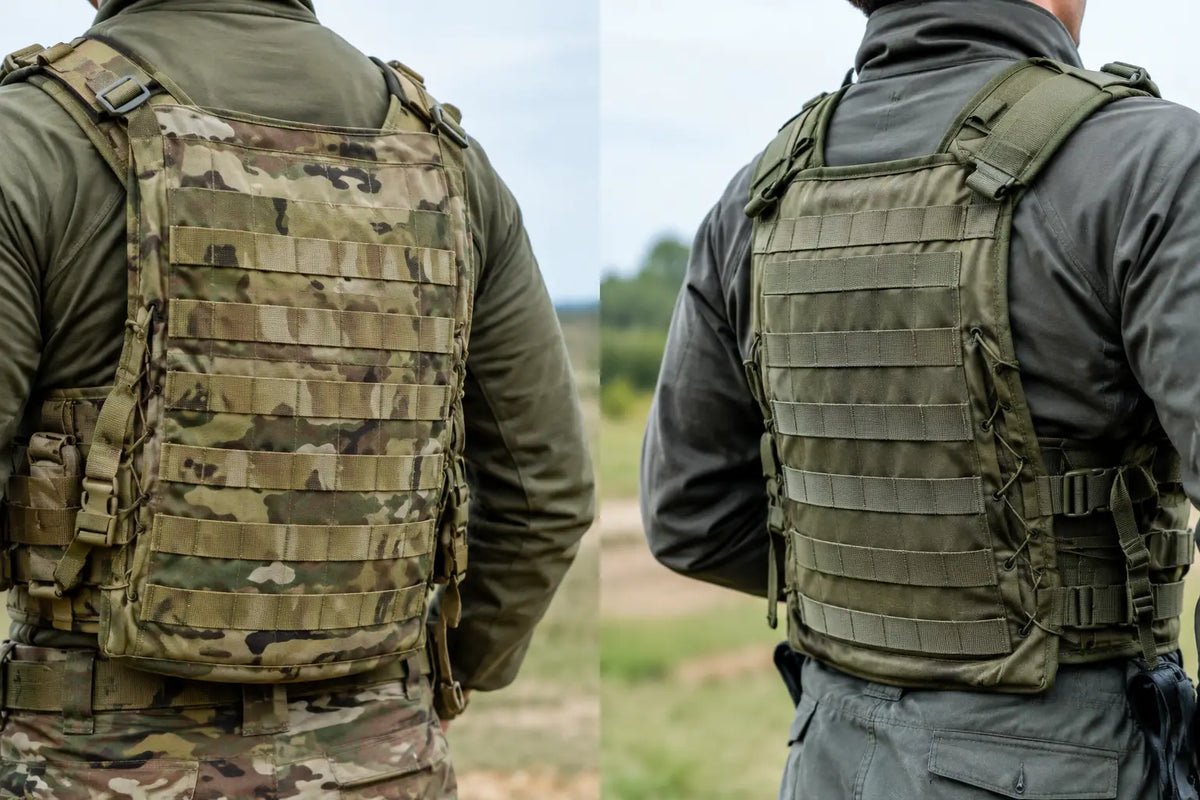
MOLLE, short for Modular Lightweight Load-carrying Equipment, uses rows of webbing stitched to a base platform. Pouches attach through woven straps, allowing the user to place compatible items almost anywhere there is suitable webbing. You will find MOLLE on plate carriers, chest rigs, assault packs, belts and patrol packs, as well as many modern pouch designs.
The central distinction is simple. PLCE is a more defined webbing system built around proven pouch positions and broad waist-borne load carriage. MOLLE is an attachment standard that allows a far greater degree of configuration. More choice is not automatically better, however. A poorly planned MOLLE layout can be bulky, slow to access and heavier than a well-set-up PLCE rig.
Why PLCE still earns its place in the field
PLCE was developed with dismounted soldiering in mind. Its large pouches readily carry rations, water, ammunition, waterproofs, gloves, field dressing, torch, notebook and other daily essentials. The weight sits on a padded belt and is stabilised by shoulder yoke straps, which can be comfortable over long distances when correctly adjusted.
For woodland, training areas, bushcraft and extended patrol-style activity, this capacity remains a genuine strength. The rear pouches are particularly useful for items that need to be carried but not constantly handled, while the front pouches keep mission-critical equipment within reach. With the main load held at the hips, a PLCE set can also work well beneath a bergen or patrol pack, provided both items are fitted carefully.
Traditional PLCE systems tend to have fewer decisions to make. Choose the appropriate belt size, fit the yoke, arrange the core pouches sensibly and keep the front clear enough to go prone. That simplicity suits users who want dependable load carriage rather than a continual cycle of reconfiguring their kit.
There are limits. Large belt pouches can foul vehicle seats, make it harder to sit comfortably and become awkward in confined spaces. They may clash with modern body armour or plate carriers, particularly where a cummerbund, side plates or belt-mounted equipment already take up space. A full PLCE set also has a distinct profile, which is useful for capacity but less suited to discreet security work or compact close-protection roles.
PLCE is strongest when capacity matters
If the requirement is to carry a practical field load for hours, PLCE is difficult to dismiss. It offers generous pouch volume, familiar organisation and a stable platform for sustained use. It is especially suited to cadet field exercises, military-style training, woodland work and users building a British Forces-inspired belt order.
The best results come from restraint. Do not fill every pouch simply because the space is available. Heavy items should sit close to the belt, balanced left to right, while the front remains clear enough for kneeling, crawling and going prone. Water, ammunition and medical essentials need positions that can be reached without taking the rig off.
Where MOLLE is the better option
MOLLE makes more sense when the load needs to change according to role. A police officer, range user, security professional or airsoft player may need a compact set-up one day and a larger sustainment load the next. A modular belt, chest rig or plate carrier can be configured around radio equipment, medical pouches, magazines, utility pouches and admin items without replacing the entire platform.
It also integrates naturally with modern armour systems. Magazine pouches can sit on the front of a plate carrier, communications equipment can be positioned to one side, and a small assault pack or hydration carrier can be mounted to the rear. This keeps equipment on the torso rather than entirely at the waist, which can be useful in vehicles and built-up environments.
MOLLE's flexibility has a cost. Every pouch needs to be compatible, properly woven and securely fixed. Cheap or badly fitted attachments can move, sag or detach. The webbing itself adds material and weight, and rows of unused webbing can catch dirt and vegetation. A large number of small pouches can also create a cluttered layout that is harder to use under stress than a simpler system.
Configuration needs a clear purpose
A MOLLE platform should be built from the task backwards. Start with the items that must be accessed immediately: magazines, first aid, radio, torch or communications equipment. Then add equipment needed during the day, followed by lower-priority sustainment items. If an item is rarely used, it may belong in a pack rather than on your chest or belt.
Pay close attention to mounting height. A pouch that looks correct while standing may obstruct a belt, vehicle seat or rifle butt when moving. A front panel packed too deeply can make going prone uncomfortable, while a heavily loaded battle belt can pull down unless supported by a properly fitted inner belt or harness.
Comfort, access and movement
Neither system can be judged on capacity alone. A webbing set-up that feels satisfactory for ten minutes in a shop may become a problem after several miles, during wet-weather drills or when worn beneath a pack. Fit it while wearing the clothing and armour you actually intend to use.
PLCE generally concentrates the load around the hips. This can reduce pressure on the shoulders, but the belt must be tight enough to stay put without restricting breathing or movement. The yoke should stabilise the belt, not carry all the weight. Rear pouches should not protrude so far that they force the wearer forward when sitting or lying down.
MOLLE can distribute weight across the torso, belt and shoulders, depending on the platform. That can be effective, though a plate carrier loaded with water, magazines, tools and utility pouches quickly becomes hot and fatiguing. For long foot movement, spreading equipment between a carrier or chest rig, belt and pack often feels better than loading one area heavily.
Access is personal, but it should be tested methodically. Can you reach essential equipment with either hand? Can you reload, access a field dressing or retrieve water while kneeling? Can you open pouches with gloves on? These questions matter more than whether the layout appears tidy.
Choosing the right system for your use
Choose PLCE when you need a capable belt order for longer field use, prefer familiar British military-style organisation or want substantial pouch capacity without putting everything on a plate carrier. It is a sensible choice for fieldcraft, cadet exercises, outdoor work and traditional infantry-style load carriage.
Choose MOLLE when modularity, armour integration or a compact role-specific layout is the priority. It is well suited to plate carriers, chest rigs, tactical belts, range equipment, airsoft and jobs where radio, medical or magazine placement changes according to the task.
There is also no rule stating that one system must replace the other. Many users combine principles from both: a stable belt with selected MOLLE pouches, a compact chest rig supported by a belt order, or a plate carrier for immediate equipment with a patrol pack for sustainment. The important point is that each layer has a defined purpose and does not obstruct the next.
At John Bull Clothing, the sensible approach is to select the platform around the work you expect it to do, then add proven pouches only where they earn their place. Set it up, wear it under load, move through realistic positions and adjust it before relying on it in the field.