
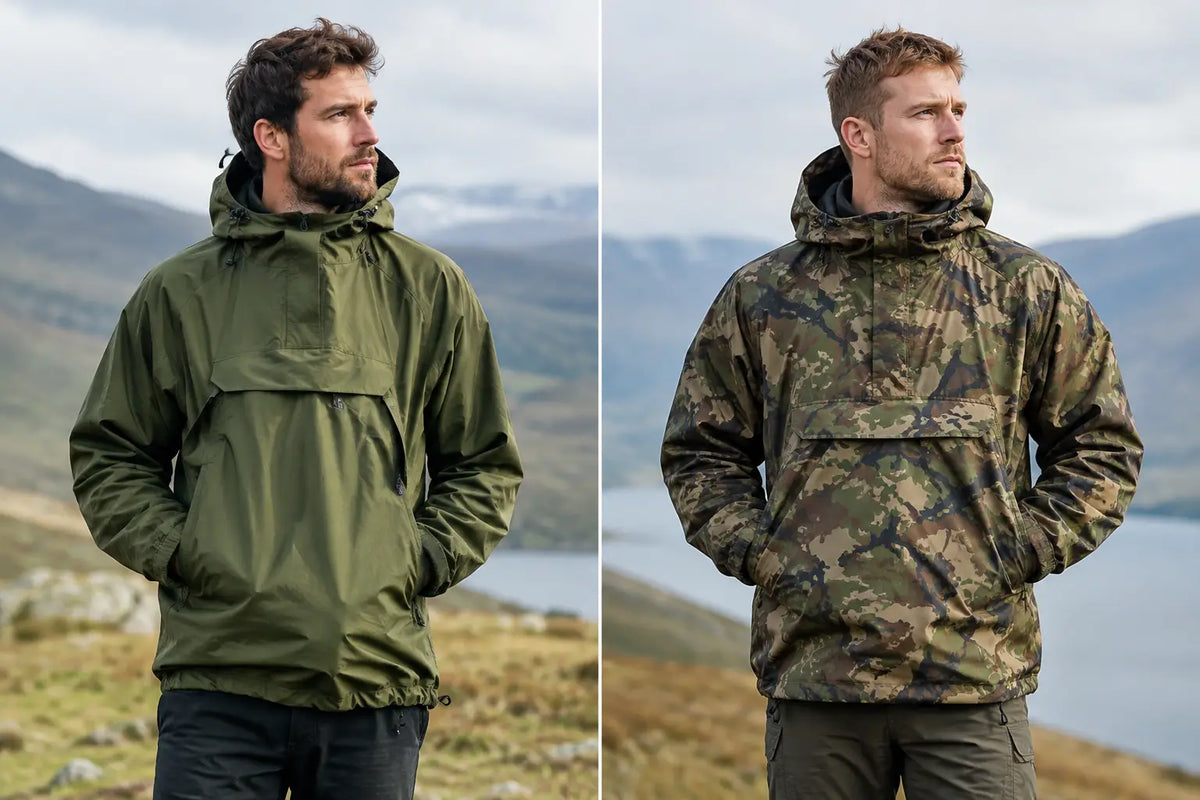
A montane smock or buffalo smock can both earn a place in a field kit list, but they are built around different answers to the same problem: staying functional when the weather turns and the pace changes. Choosing on appearance alone is a mistake. The right smock depends on whether you need a tough wind layer, a flexible insulation system, or a garment that keeps working through cold rain and sustained movement.
For hill days, fieldcraft, patrol tasks and outdoor work, the key question is not which brand is better. It is what you will be doing while wearing it, what you will wear underneath, and how quickly you can add or remove layers when conditions shift.
Montane smock or Buffalo smock: the core difference
A Buffalo smock, particularly the well-known Special 6 style, is an active insulation system. It combines a wind-resistant Pertex outer with a deep pile lining. The idea is simple: wear it directly over a light base layer, keep moving, and let the system manage warmth and moisture. It is not designed to be worn like a conventional fleece beneath a waterproof jacket.
A Montane smock is a broader category. Montane produces lightweight windproof smocks, softshell layers, insulated pull-ons and waterproof shells. That gives more choice, but it also means there is no single Montane smock experience. One model may be a packable windshirt for fast hill movement; another may be a hard shell intended to sit over several layers.
In practical terms, Buffalo is a specialised cold-and-wet active layer. Montane offers more modular options for users who build a conventional layering system around base layers, fleece or insulation, and a shell.
When a Buffalo smock is the better field layer
A Buffalo smock excels when conditions are cold, damp and unsettled, and you expect to remain active. Think winter navigation, wet ground work, long hill approaches, dog walking in poor weather, or training days where stopping to repeatedly adjust layers is inconvenient.
The pile lining traps warmth while moving moisture away from the body. If the outer face gets wet, the garment can still retain useful warmth because the pile does not collapse in the same way as a soaked fleece. Its large front vent, side zips and adjustable hood are not minor details - they are central to controlling heat output when carrying a pack, moving uphill or working hard.
That simplicity is one reason Buffalo kit has a loyal following among people who spend long periods outdoors in British weather. It can reduce the amount of clothing required: a wicking base layer, the smock, and suitable lower-body clothing may be enough for a demanding day.
There are trade-offs. A Buffalo smock is bulky compared with a lightweight shell, and it is very warm. On a mild day, during close-quarter work, or when travelling between locations, it can be too much garment. It is also not a waterproof shell. The Pertex outer sheds wind and light rain well, but prolonged heavy rain will eventually get through.
Wear it with the right base layer
The Buffalo system works best over a thin, wicking synthetic or merino base layer. Avoid heavy cotton T-shirts. Cotton holds moisture, dries slowly and undermines the moisture management that makes the smock effective.
Do not automatically add a thick fleece beneath it. That is a common error and usually leads to overheating. If you are stationary for long periods, add insulation over the top during halts, or carry a roomier waterproof shell for sustained rain and wind exposure.
When a Montane smock makes more sense
A Montane smock is usually the better choice when versatility, low weight and packability matter. A lightweight windproof smock works well over a base layer or mid-layer during fast movement. It keeps wind chill down without creating the heavy warmth of pile insulation, making it useful for spring and autumn training, running, scrambling, cycling and dry hill days.
A waterproof Montane smock, by contrast, suits those who need dependable rain protection as part of a layered system. Pair it with a fleece, light synthetic insulation or both, depending on temperature and activity. This approach gives more control over warmth because each layer can be used separately.
For patrol, security, range work or general outdoor duties where the day may involve driving, standing, short walks and occasional rain, a conventional layering arrangement is often easier to manage. A shell can be packed away when the weather improves, while an insulation layer can be added only when static.
The limitation is complexity. A modular system demands that you carry and manage more items. If you begin cold, work hard, then stop, you need to anticipate those changes and adjust before sweat becomes a problem. Buffalo’s appeal is that it handles a narrower set of conditions with less thought, provided you keep moving.
Weather protection and breathability in real use
Neither choice removes the need to plan for the forecast. A Buffalo smock deals impressively with wind, cold and intermittent rain, but it should not be treated as your only storm protection on an exposed route. In persistent rain, particularly when stationary, a proper waterproof shell remains the sensible safety layer.
Montane waterproof smocks offer better direct rain defence, but breathability claims should be viewed realistically. Any waterproof membrane has limits. A hard ascent under load can generate more moisture than a shell can shift, especially when rucksack straps and chest straps restrict ventilation. Pit zips, front zips and sensible pacing matter as much as the fabric specification.
Windproof Montane smocks generally breathe more freely than waterproof shells, but they do not provide the same protection in sustained rain. For many users, that is an acceptable compromise. A windshirt and a separate waterproof packed in the rucksack can be a very efficient combination.
Fit, pockets and equipment compatibility
Fit should be checked wearing the layers you intend to use. A Buffalo smock needs enough room for unrestricted movement and airflow, but it should not be so oversized that the sleeves, hood and body snag on webbing or catch wind. Its large kangaroo-style storage and handwarmer pockets are useful for maps, gloves and quick-access items, though they can be obstructed by waist belts.
With a Montane smock, inspect pocket placement against your rucksack and load carriage. High hand pockets are generally more useful with a hip belt. A chest pocket can be better for a compass, mobile phone or notebook, but avoid overloading it if you are covering ground at speed.
For tactical or military-inspired use, colour and finish may matter as much as the cut. A subdued olive, coyote or dark earth layer is often more suitable for fieldcraft than a bright mountain colourway. Consider noise too. Some lightweight shell fabrics are noticeably rustly, which may be irrelevant on an open hill but less welcome during low-profile movement.
A practical buying decision
Choose a Buffalo smock if your typical day is cold, wet, windy and active, and you want a proven all-in-one insulation layer that performs with minimal layering. It is particularly effective for users who know they run cold, spend extended time outdoors and are prepared to carry a waterproof shell for severe weather or long static periods.
Choose a Montane smock if you need to tailor your clothing system to changing tasks and temperatures. A windproof smock suits high-output movement and compact packing. A waterproof smock suits rain protection within a conventional layer setup. An insulated option can cover cold, dry stops without committing to the bulk of a pile-lined garment.
At John Bull Clothing, the best choice is always the one that matches the ground, weather and task rather than the label on the chest. Build your system around how you actually operate. A smock that stays in the rucksack because it is too warm, too fragile or poorly matched to your layering is not dependable kit - however good it looked on the hanger.