
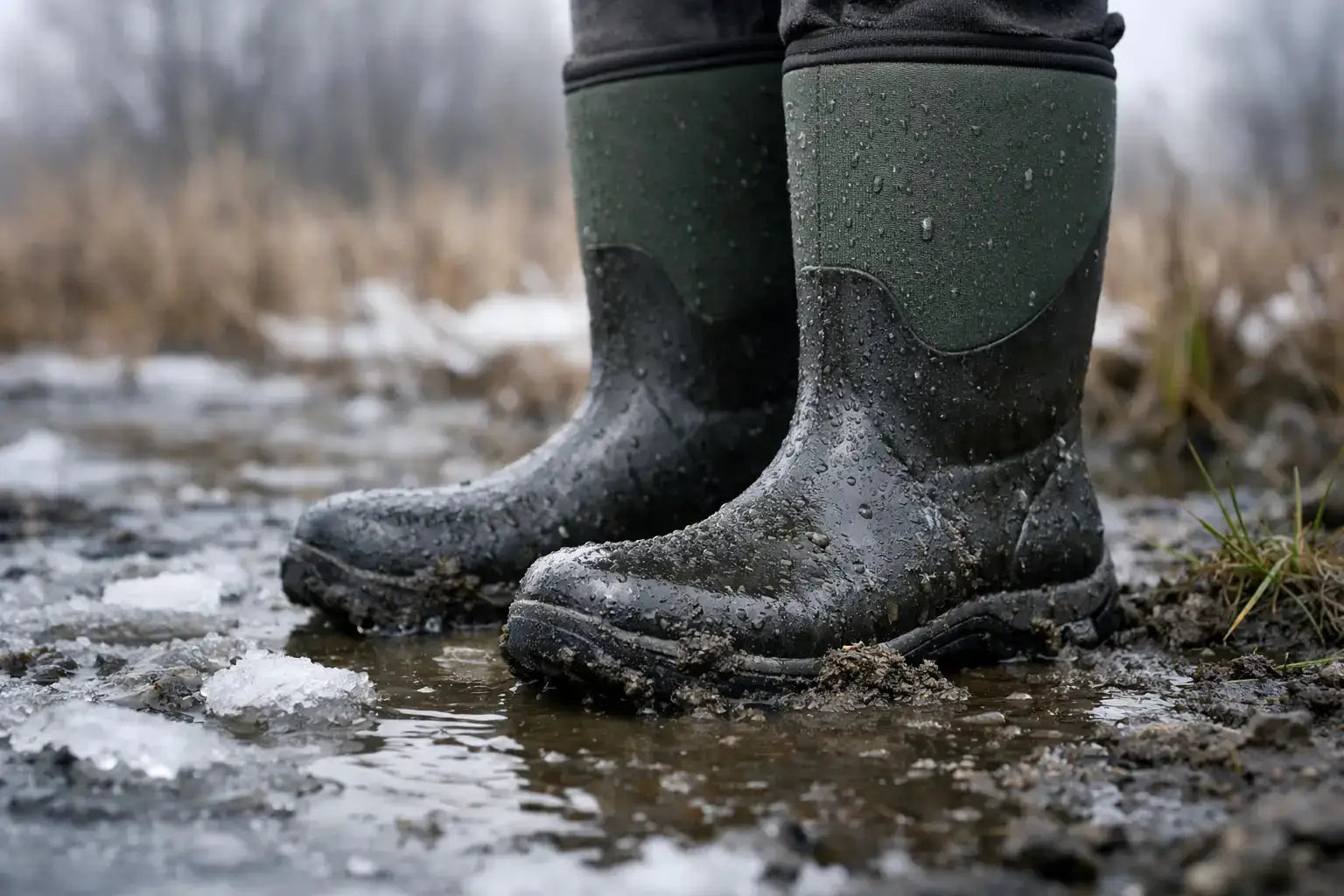
A wet gate line at first light, a flooded track, a long dog walk through winter grass - these are the conditions that answer the question, why use a neoprene wellie? A standard rubber wellington keeps water out, but a neoprene-lined wellie also helps retain warmth around the foot and lower leg. For anyone spending hours outdoors rather than simply crossing a puddle, that difference is significant.
Neoprene wellies are built for cold, muddy and consistently wet ground where dry feet alone are not enough. They suit country work, field sports, fishing, stable duties, dog walking, campsite tasks and general outdoor use. They can also be useful kit for personnel and cadets working around wet training areas, provided the task does not require a safety boot or a more supportive patrol boot.
Why Use a Neoprene Wellie Rather Than Standard Rubber?
The main difference is the lining. Neoprene is a synthetic rubber foam containing tiny air pockets. Those pockets slow heat loss, creating insulation without the bulk of a thick sock. A quality neoprene wellie therefore gives the wearer a waterproof outer shell with a warmer, more forgiving inner boot.
This is particularly useful when standing still. Walking generates heat, but waiting at a peg, checking livestock, working a gate, watching a training area or attending to equipment in rain can quickly chill the feet. Cold feet reduce comfort and concentration, and they can turn an otherwise manageable day outside into a short one.
A neoprene lining also tends to make a wellie easier to wear for extended periods. It provides some cushioning against the lower leg and can reduce the cold, clammy feel often associated with unlined rubber boots. That does not make every neoprene wellie equally comfortable - footbed quality, fit, sole construction and sock choice still matter - but it is a clear step up from basic festival-style wellingtons.
Warmth Without Losing Waterproof Protection
A wellie is fundamentally a waterproof boot. Its high shaft protects the lower leg from surface water, long grass, mud and shallow standing water in a way that most walking boots cannot. Where water is likely to come over the ankle, a waterproof membrane boot is not the same thing as a full rubber wellie.
The neoprene section adds warmth, but it should not be confused with a guarantee against every temperature. The level of insulation varies between models, and manufacturers may state a comfort range to indicate intended use. That range is a useful guide, not an absolute rule. A person standing still in wind and rain will feel cold sooner than someone walking briskly, while a thick technical sock can alter the feel of the boot considerably.
For typical British autumn and winter conditions, a neoprene-lined wellie is often a practical choice. It deals well with saturated ground, wet grass and persistent drizzle while offering more warmth than plain rubber. In milder weather, however, a heavily insulated model may feel too warm, particularly during hard work or long walks.
The right sock still matters
Neoprene performs best with a sensible sock system. A moisture-wicking walking or work sock helps manage perspiration and reduces rubbing. Avoid relying on a thick cotton sock to solve a poor fit: cotton holds moisture, and excessive bulk can make toes feel cramped. If the boot is properly fitted, a medium-weight wool blend or technical synthetic sock is usually more useful than piling on layers.
Comfort, Flex and Fit in the Field
Good neoprene has natural stretch. This gives the upper a closer, less restrictive fit around the calf than a rigid rubber shaft, and it makes getting the boot on and off more straightforward. Adjustable calf gussets can be useful for wearers who need room for trousers tucked in, thicker socks or a broader calf.
Fit should be checked as carefully as it would be with any field boot. Your heel should remain reasonably secure when walking, your toes should not touch the front of the boot on downhill ground, and there should be enough room for the socks you actually intend to wear. Try wellies later in the day if possible, when feet are naturally a little larger.
A boot that is too loose can rub at the heel and allow the foot to slide inside on uneven ground. One that is too tight reduces insulation by compressing the lining and restricting circulation. The aim is a secure fit with enough room to move the toes.
Footbeds are worth attention as well. Some neoprene wellies include a more supportive removable insole, while others have a basic flat footbed. If you will be covering distance, working all day or carrying kit, a supportive insole can make a real difference. Replace a worn or flattened insole before assuming the entire boot has reached the end of its useful life.
When a Neoprene Wellie Is the Right Tool
A neoprene wellie is strongest where waterproof height and warmth are the priority. It is well suited to muddy estates, wet shooting ground, farm tracks, flooded campsites, riverbanks, stable yards and everyday rural work. It is also practical for outdoor chores where footwear may need to be rinsed clean quickly at the end of the day.
For short-to-medium distances on soft, wet ground, the comfort is usually excellent. The high shaft prevents water and debris entering from above, while the sole should provide grip through mud and wet grass. Look for a deep, self-cleaning tread rather than a shallow fashion sole if grip is central to the job.
On cold, hard ground, the thicker sole and insulated upper can also be welcome. However, traction is not only about tread depth. Wet leaves, clay, polished concrete, ice and greasy wooden walkways can all be slippery. Move carefully, and select footwear with a sole suited to the surface rather than assuming any wellie will grip everywhere.
Where a Wellie Has Limits
A neoprene wellie is not a replacement for every boot in the kit locker. On steep, rocky or heavily uneven terrain, a lace-up walking or patrol boot gives better ankle retention, more precise foot placement and usually greater stability under load. A tall wellie protects against water, but its looser shaft cannot offer the same ankle support as a properly laced boot.
It is also not automatically a safety boot. If you are working around vehicles, machinery, heavy loads, construction materials or other workplace hazards, check the required safety rating. You may need a certified toe cap, midsole protection, slip resistance or chemical resistance. Never substitute a general-purpose wellie where site rules call for certified PPE.
For operational, security or airsoft use, consider the terrain and task before choosing wellies. They are useful for static wet-weather duties, waterlogged ground and vehicle-based activity, but not usually the first choice for long tactical movement, running, climbing or carrying heavy webbing over difficult ground. A dependable pair of patrol boots remains the more versatile option in those situations.
Choosing a Neoprene Wellie That Will Earn Its Place
Start with the conditions you actually face. For regular winter use, choose an insulation level suitable for cold and wet ground rather than the warmest specification available. If your work is physically demanding, moderate insulation may prove more comfortable than a very thick lining.
Examine the sole, heel and construction. A durable rubber outsole with pronounced lugs is preferable for mud, grass and farm use. A reinforced toe and heel can help where the boot sees frequent kneeling, digging, driving or contact with rough ground. Check the upper for a secure join between rubber and neoprene, as this area sees repeated flexing.
Shaft height matters too. A full-height wellie gives maximum protection against deep puddles and wet vegetation, while a shorter model is quicker to pull on and less cumbersome for lighter tasks. If you regularly tuck combat trousers, over-trousers or waterproofs into the boot, ensure the calf opening has sufficient room without becoming loose.
Finally, choose for use rather than appearance. A good neoprene wellie should be warm, waterproof, stable enough for the ground you cover and easy to clean after use. It does not need to do the job of a mountaineering boot, a safety boot and a parade shoe at the same time.
Care That Extends the Life of Your Wellies
Mud left to dry on rubber can shorten the life of the material, particularly around flex points. Rinse boots after use with clean water, remove stubborn dirt with a soft brush and allow them to dry naturally away from radiators, fires and direct heat. Excess heat can harden rubber, weaken adhesives and damage neoprene.
Store them upright or supported so the shafts do not collapse for long periods. Keep them away from fuel, oils, solvents and prolonged sunlight. Before a wet season begins, inspect the sole, seams and lining for cracking, separation or damage. A small issue is easier to spot in the shed than halfway through a wet day in the field.
The best reason to choose a neoprene wellie is simple: when the ground is cold, saturated and unavoidable, it keeps your feet protected without making every step feel like a compromise. Match the boot to the task, fit it properly and look after it, and it will remain dependable wet-weather kit.