
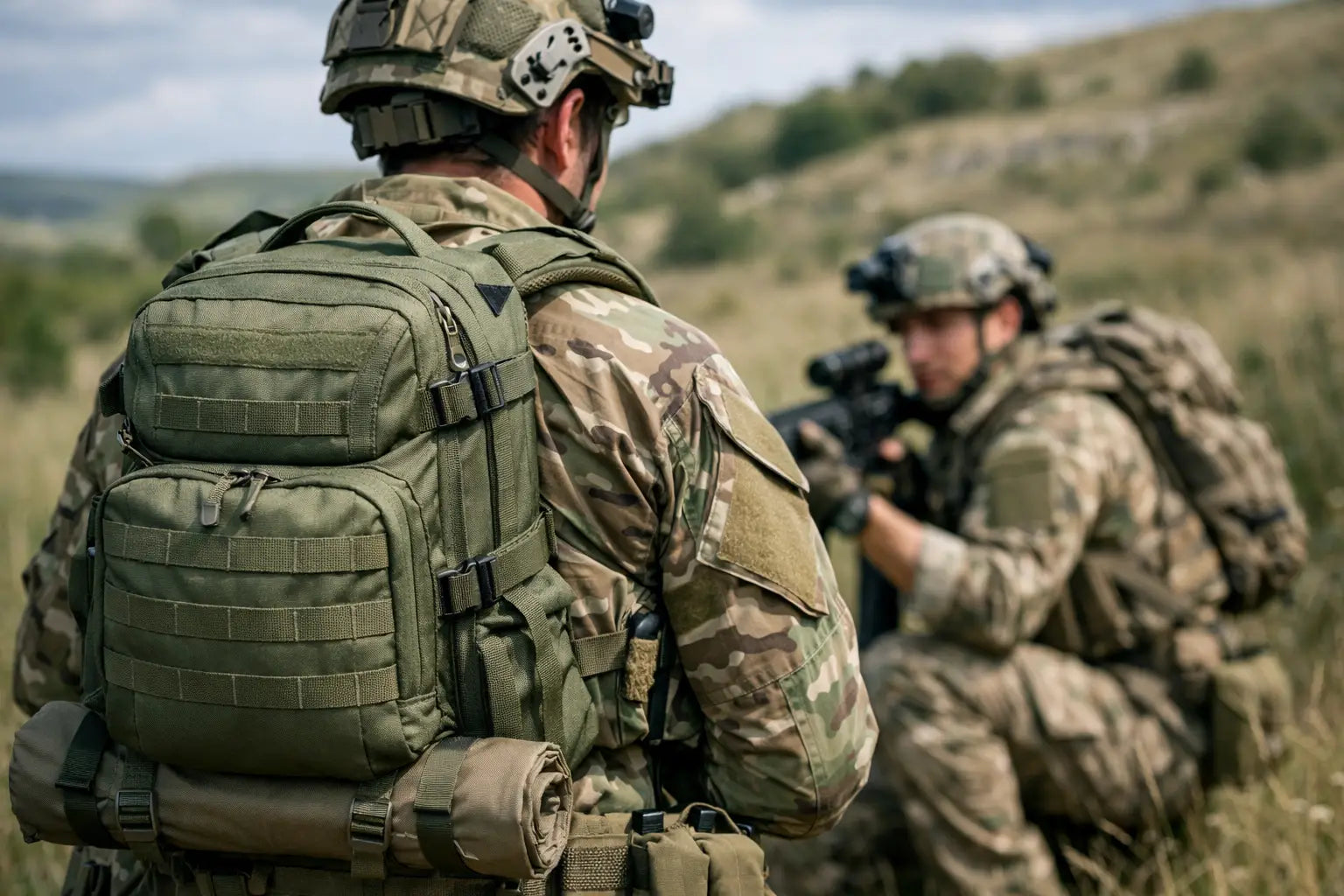
A daysack is often the item that decides whether a long day remains manageable or becomes a fight with badly placed weight, wet kit and inaccessible essentials. That is the practical answer to why use Highlander Forces daysacks: they are designed around straightforward load carriage for people who need their kit protected, organised and ready to reach without unnecessary complication.
For service personnel, cadets, security staff and regular outdoor users, the right pack is not simply about litres. It must sit correctly when moving over uneven ground, carry the equipment needed for the task, and stand up to repeated use. A Forces-style daysack offers a military-focused alternative to a lightweight fashion rucksack, with features that make sense when conditions are less forgiving.
Why use Highlander Forces daysacks for daily load carriage?
Highlander Forces daysacks are built for practical, day-length loads. That can mean spare layers, waterproofs, food, hydration, navigation equipment, first-aid supplies and small items of field kit. For commuting to a unit, range days, hill walking or airsoft, the same principle applies: your equipment should be contained, balanced and easy to find.
The range is particularly useful because it covers more than one type of user. A compact pack may suit a short patrol, dog walking, gym kit or a cadet training day. A larger daysack gives more room for cold-weather clothing, a stove, rations, wet-weather layers and a fuller set of personal equipment. Choosing the capacity around the actual task avoids the common mistake of carrying an oversized pack half empty, or cramming essential items into one that is too small.
Military-inspired construction also has a clear advantage when the pack is regularly put down on rough ground, loaded in and out of vehicles, or used in poor weather. Hard-wearing fabrics, sturdy zip closures and sensible compartment layouts are more useful than cosmetic features. A pack does not have to be complicated to work well. It needs to keep its shape, manage the load and allow a user to get on with the job.
Capacity matters, but packing discipline matters more
Daysacks are usually chosen by litre capacity, and that is a sensible starting point. It is not the whole decision. A well-packed smaller pack can be more comfortable and efficient than a large model full of loosely packed items.
For a light day out, a compact daysack can carry water, a warm layer, waterproof jacket, lunch, torch and basic personal kit without adding excess bulk. For a longer field day, look for sufficient space for food, insulation, protective clothing, navigation aids and any task-specific equipment. If you are travelling to and from work or training, consider room for boots, wash kit and a change of clothes as well.
Keep dense items close to your back and around the middle of the pack. Water, tools and food are generally better placed there than at the outer edge, where they can pull the load away from your body. Softer items can fill gaps and cushion hard equipment. Wet clothing should be separated from dry kit where possible, ideally in a dry bag or durable liner.
External pockets are useful for items needed quickly, such as gloves, a head torch, notebook, compass or snacks. They should not become a place for expensive or safety-critical items that can be lost when the pack is opened. A simple packing routine makes a noticeable difference, especially when working in the dark or wearing gloves.
Choose the size for the role, not the label
There is no single best capacity. A patrol-style day load, a school or cadet day, and a full day on the hill each demand different equipment. Think about what must be carried in the worst likely conditions, rather than what fits on a warm, dry day.
A larger pack is worthwhile when extra insulation, water or food is genuinely required. It may also be the better option for users carrying shared equipment. However, additional volume invites overpacking. More kit means more weight, and unnecessary weight affects pace, posture and fatigue. If your load is consistently heavy or includes overnight equipment, a larger rucksack with a proper hip belt may be a better choice than pushing a daysack beyond its intended role.
Fit and stability are the real test
A strong fabric is of little value if the pack bounces, rubs or leaves the shoulder straps cutting in after an hour. Fit should be checked with realistic weight inside the bag, not while it is empty on a shop floor.
Set the shoulder straps so the pack sits high and close against the back, without restricting movement around the neck and shoulders. If the model includes a sternum strap, use it to stop the shoulder straps spreading outwards. It should stabilise the load, not be pulled tight enough to restrict breathing. Compression straps should be adjusted once the pack is loaded, reducing movement and keeping the contents compact.
Back length is worth considering for both shorter and taller users. A pack that is too long can catch on a belt line or push into the lower back. One that is too short may place most of the weight on the shoulders. Try it while wearing the layers, belt kit or body armour you expect to use. What feels acceptable over a T-shirt can feel entirely different over a combat jacket or plate carrier.
For people carrying water regularly, compatibility with a hydration bladder can also be more practical than relying on bottles alone. It helps maintain access to fluids while moving, although bottles are easier to refill and monitor. Many users carry both: a bladder for the main supply and a bottle for immediate use or mixing drinks.
Organisation should support the task
The best compartment layout depends on how you work. A single large compartment is quick to pack and can take awkward items, but smaller pieces of kit may disappear at the bottom. Multiple compartments provide better separation, though they can limit flexibility when carrying bulky clothing.
For general field and outdoor use, a main compartment with a smaller front pocket is often enough. Keep the main load in the largest section, then reserve the smaller pocket for frequently used essentials. Internal organisers are helpful for pens, documents, batteries and cables, but avoid depending on lots of tiny pockets if you will be using the pack in rain, mud or low light.
Modular attachment webbing can be useful where extra pouches are needed for a particular role. It allows the pack to be adapted for medical equipment, tools or additional storage. The trade-off is bulk and snag risk. Add pouches because they solve a real access problem, not simply because there is space to attach them.
Colour and finish are also functional decisions. Camouflage patterns suit field use and airsoft, while black, olive and neutral shades are often appropriate for work, travel and outdoor use. Check any unit, event or workplace requirements before buying. A civilian outdoor walk and a cadet exercise may allow different choices from an operational environment.
Durability needs sensible care
A dependable daysack should tolerate hard use, but it will last longer if it is looked after. After a wet, muddy exercise, empty the pack, brush off loose dirt and allow it to dry naturally in a ventilated space. Do not leave damp clothing or food inside, particularly in a warm vehicle or cupboard.
Check zips, stitching, buckles and straps before a trip rather than when you are already on the move. Small issues are easier to deal with early. Avoid dragging a loaded pack across rough surfaces when it can be lifted, and do not overload attachment points with heavy items. These habits matter as much as the original build quality.
Water-resistant fabric can shed a shower, but it is not a guarantee that the contents will stay dry through prolonged rain. A pack cover may help in some conditions, but a pack liner or dry bags provide more reliable protection for maps, electronics, spare clothing and sleeping kit. Treat waterproofing as a system, not a claim on a label.
A practical choice when the day has a job to do
Highlander Forces daysacks suit users who want military-relevant carry options without paying for features they will never use. They can serve as dependable daily packs for training, work, travel, shooting, fieldcraft and outdoor days, provided the capacity and fit match the load.
At John Bull Clothing, the sensible approach is to choose a pack around your normal task, then leave enough margin for the weather and essential kit. Load it properly, adjust it under realistic conditions and keep it maintained. A daysack that carries comfortably and keeps the right equipment to hand earns its place every time you shoulder it.