
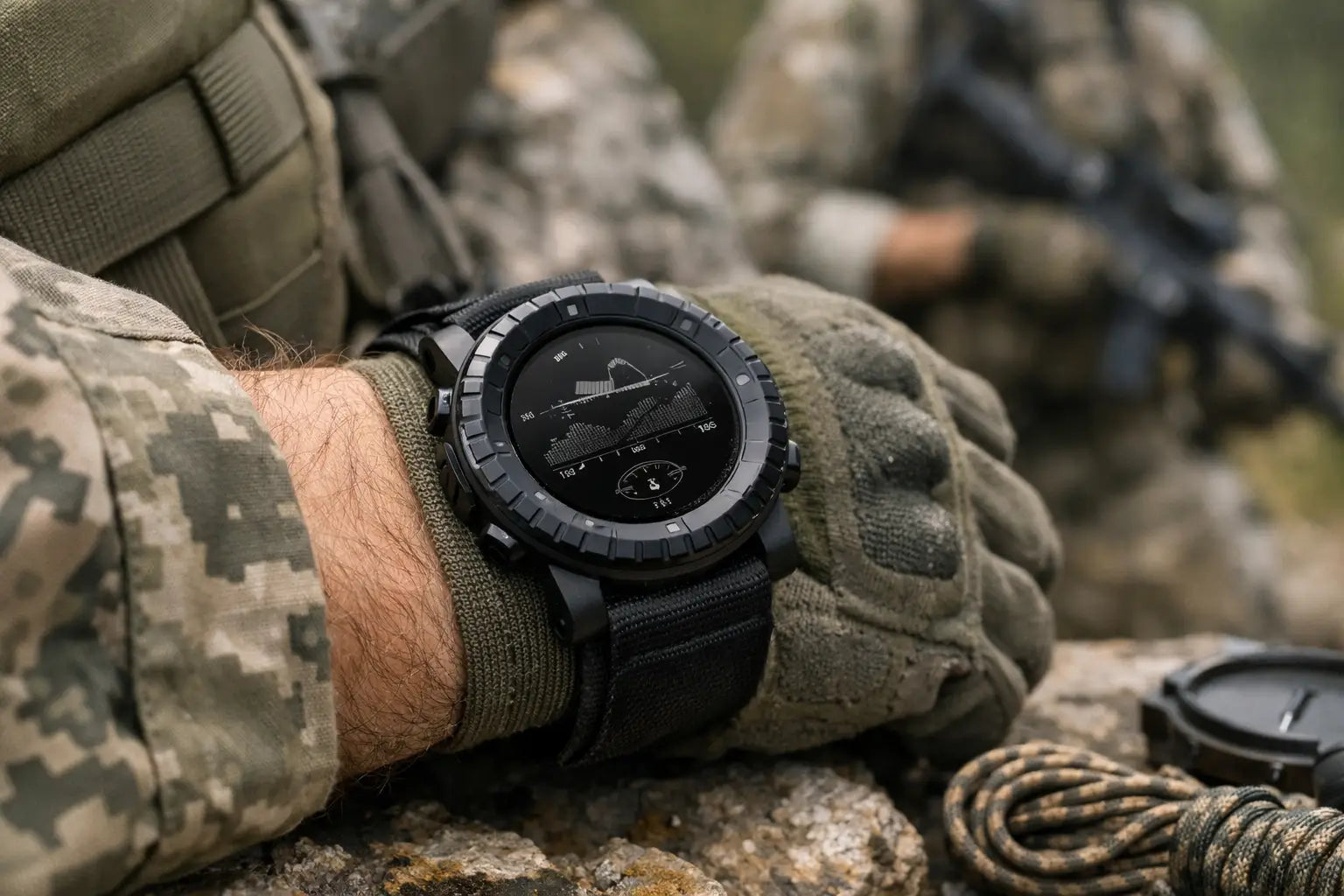
A watch that gives a bearing, tracks a change in weather and helps confirm height gained can earn its place on field kit. The {Suunto Core 2 military watch](https://www.johnbullclothing.com/products/suunto-core-2-outdoor-tactical-watch-black) is used by those that live outdoors and are looking for a hard-wearing watch with a military appearance, rather than a smartwatch loaded with notifications.
Suunto’s Core range and purpose-built variants such as the Core Alpha have changed over time, and features can differ between editions. The main question remains the same: does an ABC watch suit the way you navigate, train and operate?
What an ABC watch does in the field
ABC stands for altimeter, barometer and compass. These are practical tools, not decorative extras. A barometric trend can give an early indication of worsening weather; the altimeter helps monitor ascent and descent; and the digital compass provides a quick reference bearing when map work is under way.
For hill walking, exercise areas, stalking, fieldcraft and general outdoor work, this is useful information at wrist level. You do not need to unpack a handheld device to check a direction or see whether pressure is falling sharply. A Core-type watch also normally provides core timekeeping functions, alarms, a stopwatch and date display - the straightforward functions that matter when timings need to be kept cleanly.
Its value is greatest when it supports established navigation skills. A watch compass is a useful check, but it is not a replacement for a properly set Silva-type compass, a current map and the ability to use both. Likewise, an altimeter gives a helpful indication of position on contour-heavy ground, but weather pressure changes can affect its reading.
Suunto Core 2 military watch: what to check
The phrase “military watch” can suggest a single standard, but there is no universal definition. For one user it means a black, low-reflective watch suitable for field clothing. For another, it means a device that must work through repeated wet weather, knocks against webbing and long periods away from a charging point.
Start with the case, bezel and strap. A large display is easier to read at a glance and while wearing gloves, although a larger watch can catch more readily on cuffs, straps and load carriage. Mineral crystal and composite construction are common choices for this category: they keep weight sensible, but they are not invulnerable. A protective cuff or careful placement under a sleeve may be worthwhile during abrasive work.
Also consider the display backlight. A clear illumination system is useful in a harbour area, on a night walk or when checking timings before first light. However, anyone working where light discipline matters should avoid unnecessary illumination and assess whether the particular model has appropriate low-light or night-vision compatibility features. Do not assume every black outdoor watch has them.
Water resistance needs reading properly as well. It may be more than adequate for rain, river crossings and routine outdoor use, but a stated water-resistance rating does not automatically make a watch a dive instrument. Rinse off saltwater, inspect the seals and follow the manufacturer’s guidance after battery changes.
Battery power is a genuine advantage
A conventional battery is one reason many users still favour an ABC watch over a colour-screen GPS unit. A Core-style watch is designed for long service between battery replacements, commonly around a year depending on use and model. That removes the daily charging routine and makes it well suited to camps, expeditions and deployments where charging access is limited.
The trade-off is that it will not normally provide live mapping, route recording or location sharing in the manner of a modern GPS watch. If your requirement is to navigate a planned route using grid references, mapping and tracks, a dedicated GPS device or GPS watch is the more capable option. It will also demand a sound power plan.
For many users, the sensible arrangement is not one device replacing another. Carry a map and compass as the navigation foundation, use a GPS unit when the task requires it, and wear the Suunto for time, direction, elevation and weather awareness. Each item then has a clear role.
Calibrate before relying on it
An electronic compass needs calibration. Do this away from vehicles, metal tables, weapons systems, mobile phones, magnetic clasps and other sources of interference, following the instructions for the model. Set the correct declination where the watch allows it, and compare its bearing against a known compass before heading out.
The altimeter also benefits from a known reference point. Set it at a confirmed height when beginning a route, then check it again during the day if pressure conditions are changing. This is basic preparation, but it makes the information far more useful when visibility closes in.
Who it suits best
A Suunto Core-style watch suits the user who values simple, independent functions over connected features. It is particularly practical for cadet training, hill days, range and exercise activity, outdoor work, airsoft and general expedition use. Veterans and serving personnel who prefer a familiar watch format over another rechargeable screen may also find the layout more useful than a fitness-led smartwatch.
It is less suitable for someone who wants detailed maps on the wrist, heart-rate metrics, recovery data or turn-by-turn route guidance. It is also not a substitute for issued equipment or a required navigation system where a unit’s SOPs specify particular kit. Operational suitability is always determined by the task, chain of command and local policy, not by the colour of the case.
For police, security and patrol users, discretion can matter as much as feature count. A plain dark watch with an uncluttered display is often easier to wear alongside uniform and PPE than a bright, oversized smartwatch. Yet a compact analogue watch may still be the better choice where only accurate timekeeping is needed and snag risk must be kept to a minimum.
Wearing and maintaining a field watch
Fit matters more than it first appears. Wear the strap securely enough that the watch does not rotate when taking a bearing, but not so tight that it becomes uncomfortable under a jacket cuff. If it is worn beneath gloves, test whether the buttons remain accessible. If you use a weapon sling, rucksack sternum strap or heavy gloves, check for pressure points during a full day out rather than judging it at the kitchen table.
Keep the sensor openings clear of mud, salt and sun cream. Rinse and dry the watch after wet ground or coastal use, and examine the strap pins and buckle for wear. A spare suitable battery stored in a dry pouch can be sensible on a longer trip, but change it in a clean, dry place to avoid compromising the seal. Reset the time, compass settings and altimeter reference afterwards.
Do not treat the storm alarm as a forecast service. A rapid pressure fall may be a useful prompt to look at the sky, review the route and put waterproofs within reach, but local terrain and weather systems remain the deciding factors. Good field judgement is still the most dependable piece of equipment.
Choosing the right setup
The best reason to choose a Suunto Core 2 military watch is not that it looks tactical. It is that you need reliable wrist-borne ABC information, long battery life and a watch that can stand up to regular outdoor use without creating another charging job. If those are your priorities, it is a well-judged addition to navigation and field kit.
Choose the exact version according to the work you actually do, confirm the water-resistance and low-light features, and practise using the compass before it is needed. A dependable watch is most useful when it has become part of your routine, not something you are learning in poor weather.