
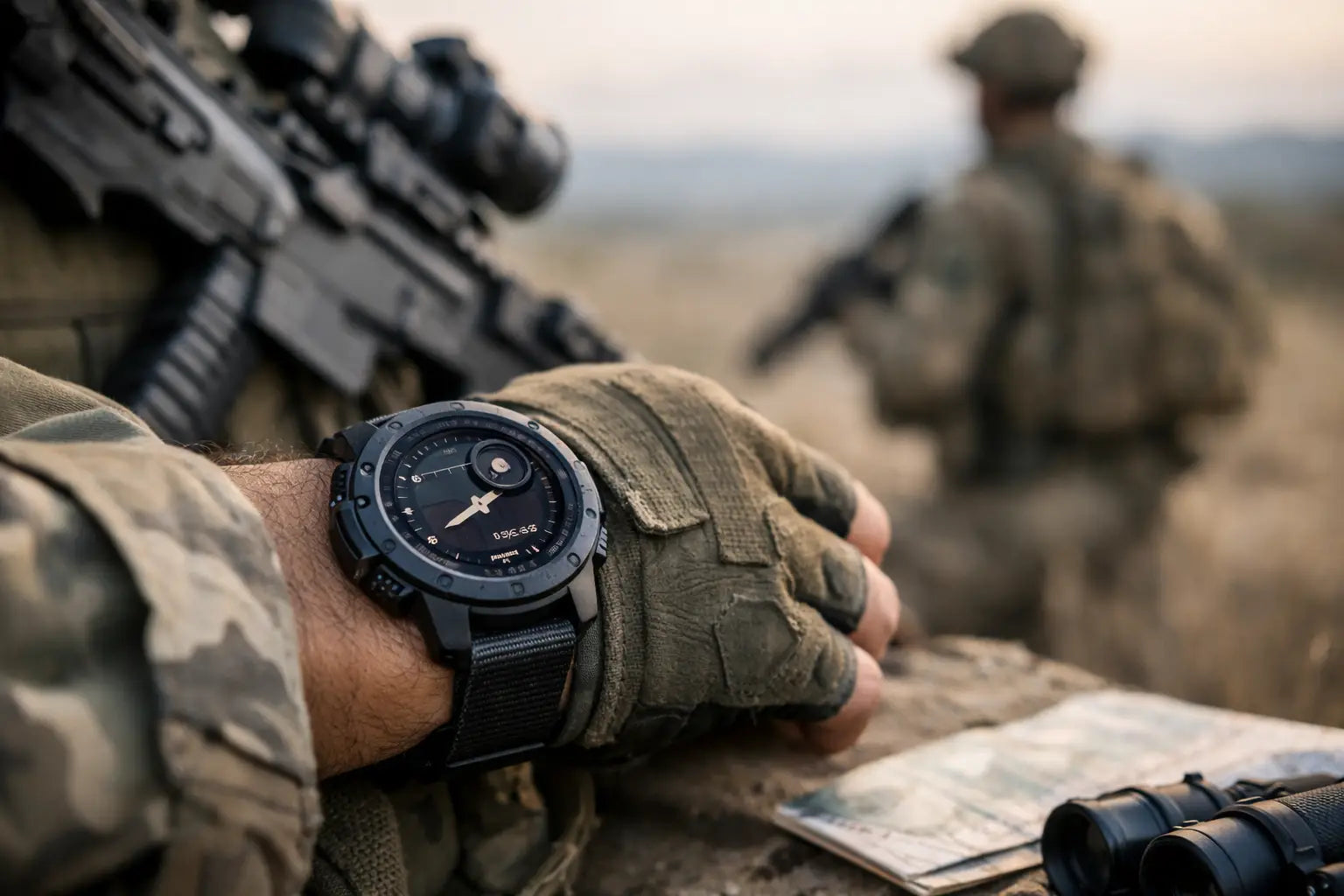
A tactical watch earns its place by being useful when a mobile phone is inconvenient, vulnerable or simply out of battery. This Garmin tactical watch review looks at what separates the Tactix range from an ordinary fitness watch, and whether its mapping, navigation and operational features justify the higher price for field, patrol and outdoor use.
Garmin's tactical watches are built around the same capable GPS and multisport platform found in its premium outdoor models, but with features aimed at military personnel, security professionals and users who need greater control over what the watch records and displays. They are not issued equipment, and they will not replace sound navigation, a map, compass or proper procedures. Used correctly, however, they are exceptionally capable pieces of personal kit.
What a Garmin tactical watch is designed to do
The current Garmin Tactix family sits at the top end of Garmin's watch line-up. Its appeal is not the tactical styling alone. The practical value comes from a hard-wearing case, long battery life, detailed navigation tools, activity tracking and specialist modes such as Stealth Mode, Kill Switch and night-vision compatibility on selected models.
For a soldier, cadet instructor, hillwalker or security operator, that means one wrist-mounted device can record a route, provide grid reference data, support navigation back to a waypoint, monitor training load and display essential notifications without repeatedly reaching for a handset. The watch is particularly useful during long days on exercise, on patrol or when travelling through unfamiliar ground.
It is worth being clear about the role of these features. Stealth Mode can stop the storage and sharing of GPS position data while continuing to show useful information. Kill Switch is intended to clear user data quickly. Neither feature makes a wearer invisible, removes the need to manage radios and mobile phones correctly, or overrides unit policy. The right use case is controlled personal administration, not a substitute for operational security discipline.
Garmin tactical watch review: build and wearability
A Garmin Tactix is a substantial watch. That is partly the point. Premium models generally use a fibre-reinforced polymer case with metal elements, a sapphire crystal lens and a secure, field-ready strap system. Sapphire is a serious advantage for users who regularly catch their watch on webbing, vehicle interiors, rock, gateposts or workshop equipment. It is far more resistant to scratching than standard glass.
The trade-off is size and weight. Larger Tactix models can feel bulky under a tight combat smock cuff, gloves or certain body armour arrangements. Those with smaller wrists may find a standard Fenix-sized watch more comfortable for daily wear. Before buying, consider whether the watch will be worn all day, every day, or mainly for training, navigation and time outdoors.
The physical button layout is another strong point. Touchscreens are useful for mapping and day-to-day navigation, but buttons remain easier to operate in rain, mud and cold weather, particularly when wearing gloves. Garmin combines both on touchscreen-equipped variants, which gives the user a sensible choice rather than forcing one method.
Water resistance and general durability are suitably confidence-inspiring, but no wristwatch should be treated as indestructible. Rinse off saltwater and grit, keep the charging contacts clean, and inspect the strap pins after demanding use. A watch that is looked after will remain dependable for far longer than one left dirty at the bottom of a bergan.
Navigation is where it earns its keep
The main reason to choose a Tactix over a basic GPS watch is navigation depth. Depending on the model and mapping option, users can work with preloaded topographic mapping, saved locations, routes, tracks, compass guidance, elevation data and coordinate formats. This is valuable for route planning, navigation training, long-distance movement and marking practical locations such as a vehicle, start point, water source or rendezvous area.
Multi-band satellite reception on compatible versions can improve position accuracy in difficult terrain, wooded areas and built-up environments. It is not magic. Dense tree cover, deep gullies, bad weather and poor satellite visibility still affect any GPS receiver. Yet compared with older single-band units, the improvement can be noticeable when a precise track matters.
For British users, the ability to work in familiar coordinate systems is especially useful. A watch should support your preferred format, but you must set it correctly before relying on it. Anyone using Ordnance Survey mapping should check the grid settings, datum and units during preparation, not when standing at a junction in poor visibility.
A paper map and compass remain essential for serious countryside use. Batteries fail, watches can be damaged and digital mapping can encourage people to follow a line without reading the ground. The Garmin is best viewed as an excellent navigation aid that supports established fieldcraft.
Mapping limitations to consider
Full mapping is easier to use on a larger display, but a watch screen is still a watch screen. It is ideal for confirming a turn, checking a bearing, reviewing the next section of a route or finding a saved point. It is less comfortable than a dedicated handheld GPS or paper map for studying a large area in detail.
If navigation is your primary requirement, decide whether you need detailed on-wrist maps or whether breadcrumb navigation and waypoint guidance will do the job. The answer can make a considerable difference to the model and price that makes sense.
Battery life for training and deployment routines
Battery performance is one of Garmin's strongest areas. Tactix watches are designed to run for days rather than requiring nightly charging, with the actual result depending on GPS use, satellite mode, mapping, pulse oximetry, notifications, screen settings and any solar charging capability.
For normal daily wear and regular training, battery life is generally more than adequate. During prolonged GPS activity, the figure drops, as it must, but Garmin offers power management settings that allow users to prioritise accuracy or endurance. This is useful on multi-day expeditions and field exercises, where switching off non-essential features can make a meaningful difference.
Do not rely on headline battery figures without considering your own use. A user recording frequent activities with maximum satellite accuracy, a bright display and all health sensors active will get a very different outcome from someone using time, compass and occasional navigation checks. Test the watch on a local route before taking it away for a long exercise.
Solar models can extend runtime in suitable conditions, but they are not self-sustaining. British weather, covered sleeves and time spent indoors all limit solar gain. Treat solar as a helpful reserve, not a guarantee that you can leave the charging lead behind indefinitely.
Training, health and everyday utility
Although tactical features attract attention, the training functions make the watch useful between exercises. Garmin's activity profiles, heart-rate monitoring, recovery indicators, pace data, strength sessions and performance metrics can help users structure running, loaded marching, cycling, swimming and gym work.
The figures need context. Wrist-based heart-rate readings can be affected by movement, cold skin and loose fit, while recovery scores are indicators rather than orders. A hard tab after poor sleep will still feel hard, regardless of what a watch says. For many users, the real benefit is consistency: seeing training volume, pace and progress over time.
Daily features such as alarms, timers, weather data, torch functions on supported models, payment options and mobile phone notifications are convenient, though not the reason to buy a Tactix. Notifications can also become an irritation. Turning off non-essential alerts is a sensible way to preserve both battery and concentration.
Is the price justified?
This is premium kit, and the cost is the main objection. A Garmin Tactix is difficult to justify if all you need is step counting, occasional runs and basic timekeeping. A less expensive Garmin outdoor or fitness watch may provide everything required.
The Tactix range makes more sense for those who will genuinely use the hard-wearing construction, advanced navigation, long GPS runtime and specialist tactical controls. It also suits buyers who want one watch for physical training, expeditions, field use and day-to-day wear rather than separate devices for each task.
Choose the exact version carefully. AMOLED displays offer excellent clarity and map visibility but usually demand more power than transflective solar-focused alternatives. Ballistics capability, aviation features and advanced mapping are worthwhile only if they match your actual activity. Paying for functions that will never leave the menu is poor kit selection.
For personnel and outdoor users who need dependable navigation and serious endurance on the wrist, a Garmin Tactix is among the most capable options available. Set it up properly, learn the navigation tools before relying on them, and keep conventional map-and-compass skills current. That is how a premium tactical watch becomes useful field equipment rather than an expensive accessory.